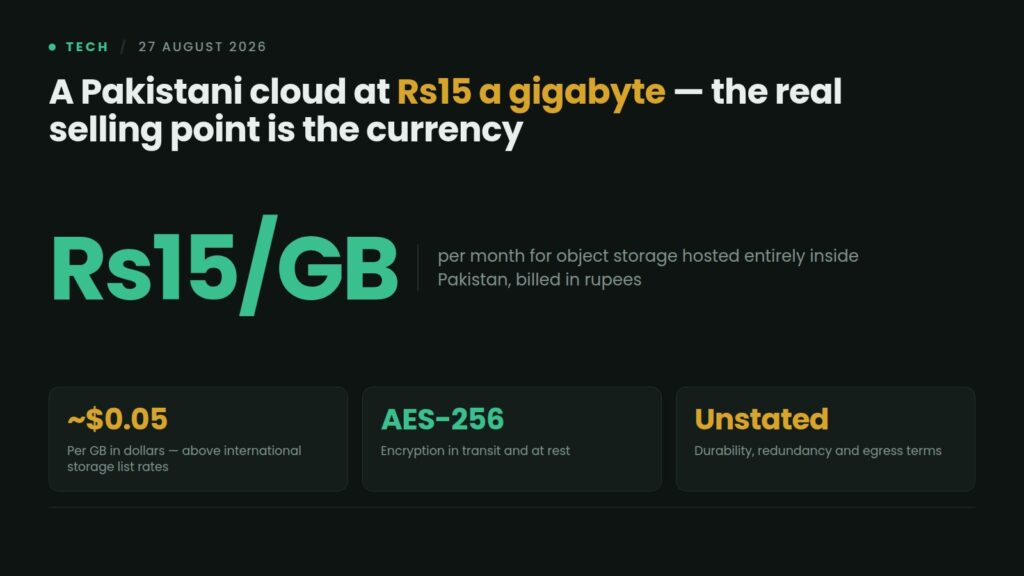
Nayatel has launched S3-style object storage hosted entirely inside Pakistan, priced at Rs15 per GB per month with no setup fee and AES-256 encryption in transit and at rest.
The pitch is not speed, and it is not really price. It is that the data stays in the country and the bill arrives in rupees.
Run the pricing comparison
At roughly Rs280 to the dollar, Rs15 per GB works out to about five US cents per GB per month.
Standard object storage at the large international providers lists at roughly half that. On headline storage rates, buying locally costs more.
That comparison is incomplete in a way that matters. Hyperscaler pricing is not one number — storage is cheap and moving data out is expensive, with egress typically charged at several times the monthly storage rate per gigabyte. For a workload that stores a lot and reads a little, the international provider wins comfortably. For one that serves media, delivers files to users or repeatedly pulls training data, egress charges dominate the bill and a flat local rate can land well ahead.
So the honest answer is that this is cheaper for some workloads and dearer for others, and any business evaluating it should model its own read-to-store ratio rather than compare headline rates.
The currency argument is the strongest one
Nayatel’s framing includes avoiding the unpredictability of dollar-denominated billing, and in Pakistan that is not a marketing line.
A Pakistani company paying an international cloud provider carries an open-ended foreign currency liability on an operating cost it cannot easily reduce. Every rupee of depreciation raises the bill without any change in usage. It is the same mismatch that constrains telecom operators buying network equipment in dollars while earning in rupees.
There is a second layer. Paying an overseas provider requires foreign exchange, and access to it has not always been straightforward for Pakistani businesses during balance-of-payments stress. A rupee invoice removes both the currency risk and the settlement risk.
Where data residency actually binds
The compliance case applies to a specific and growing set of customers.
Regulated sectors — banking, insurance, health, government — face requirements or expectations that certain categories of data remain within national borders. For them, offshore storage is not a cost comparison; it is frequently a hard stop.
Two of the listed use cases sit squarely in that territory. Surveillance footage and machine learning training datasets are exactly the categories where questions about jurisdiction get asked, and where an answer of “it is in Islamabad” is materially easier than one involving a foreign region and a data processing agreement.
This is the same argument that has been running through Pakistani infrastructure all year. Indus Cloud built an NVIDIA H200 GPU cluster on domestic soil on the reasoning that sensitive data should not have to leave the country to be processed. Pak Datacom moved satellite backup for over 400 National Bank branches to a UAE operator with the ground hubs relocated abroad, and a former chief executive objected on precisely these grounds.
Storage is the least glamorous layer of that stack and the one most businesses actually need first.
What has not been published
Several things a technical buyer would need before committing.
API compatibility. “S3” describes an interface as much as a product. Whether existing tools and libraries work unmodified against this service determines whether adoption is a configuration change or a rewrite, and it has not been stated.
Durability and redundancy. Object storage is usually sold on a stated durability guarantee, underpinned by replication across physically separate facilities. No figure has been given, and no indication of how many sites hold a copy.
Egress terms. “No hidden charges” is reassuring and not the same as a published rate card covering data transfer, request pricing and retrieval.
For backup and archive, those gaps are tolerable. For anything a business would struggle to reconstruct, durability is the number that matters most — and it is the one missing.
Why this is worth noting anyway
Pakistan has spent two years talking about sovereign digital infrastructure. Most of that conversation has been about compute, AI and national platforms.
Sovereignty at the storage layer is more mundane and more immediately usable. A mid-sized Pakistani company with surveillance archives, customer records or a media library does not need a GPU cluster. It needs somewhere to put files that is cheap, legally straightforward and billed in a currency it earns.
Whether this particular service is good enough is a question its durability figures would answer. That a local operator is competing at this layer at all is the more interesting development.
Related: The National Bank’s Satellite Backup Now Runs Through the UAE.