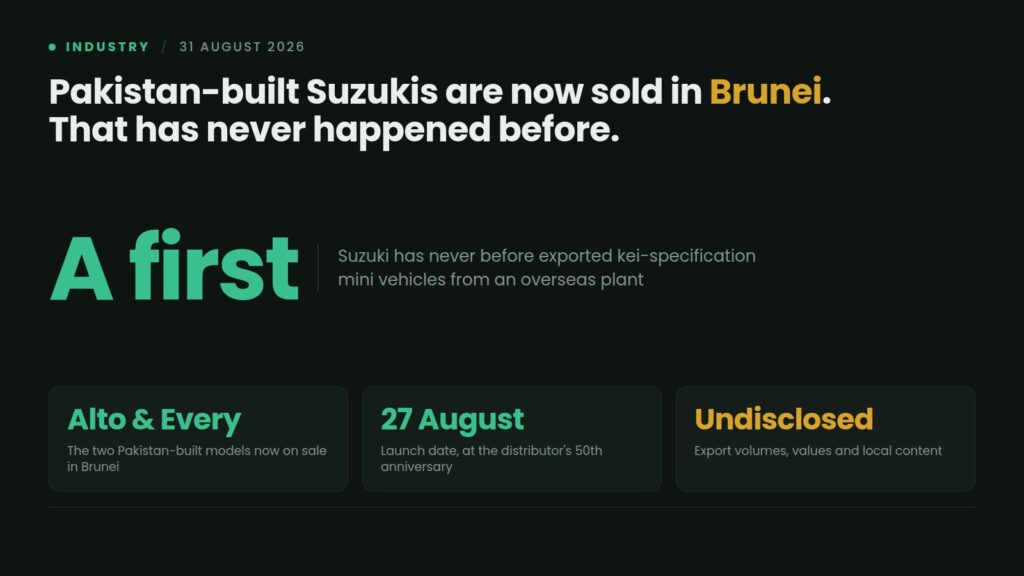
Suzuki has begun selling the Alto and Every in Brunei, and both were built in Pakistan.
The detail that makes this more than a routine export announcement: it is the first time Suzuki has exported mini-vehicle models from an overseas production base. Cars built to Japanese kei specifications, made outside Japan, sold in a third country.
The vehicles were launched on 27 August at the 50th anniversary of Boustead Sdn. Bhd., Suzuki’s Brunei distributor.
Why the kei detail matters
Kei cars are a Japanese regulatory category — strict limits on length, width, height and engine displacement, in exchange for lower tax and insurance. Building to that standard means meeting Japanese specification, and Japanese manufacturers have historically kept kei production at home.
Suzuki choosing a Pakistani plant to supply a third market with kei-specification vehicles is a judgement about that plant’s quality and cost. A manufacturer does not put its home-market specification on a line it does not trust.
For an industry that has spent three decades being told it produces expensive vehicles for a captive domestic market, an export order that had to clear a Japanese specification is a different kind of evidence than a policy target.
The timing, against everything else this month
Pakistan’s auto sector has spent August arguing about protection.
The parts association wrote to the Prime Minister warning that 1.8 million jobs are at risk as the duty premium on used-car imports falls from around 40 percent to zero by FY30. Used imports have already taken close to 30 percent of the domestic market despite that penalty. Hybrid prices rose 15.2 percent this month, some models adding over Rs2 million.
The government’s response has been consistent: the sector must shift toward exports rather than serving a protected home market. It approved a 150-acre auto import-refurbishment-export zone at Port Qasim targeting $500 million in annual exports, and has called publicly for a fundamental shift.
A Pakistani plant supplying a foreign market to Japanese specification is the first concrete evidence that the thing being demanded is possible. It arrived without a new incentive scheme attached.
What has not been disclosed
Almost every number that would let anyone size this.
No export volumes. No shipment values. No indication of whether this is a trial consignment or a standing supply arrangement. No local content percentage, which is the figure that determines how much of the value actually stays in Pakistan — a vehicle assembled from imported kits and re-exported earns far less than one built from domestically made components.
Brunei is also a very small market. Its population is under half a million, and total annual vehicle sales there are a fraction of what a single Pakistani assembler produces in a month. Whatever the volumes, they will not move Pakistan’s export numbers.
The significance is the precedent, not the tonnage.
Why it could matter more than the volumes suggest
Manufacturers do not select an export base casually. Qualifying a plant to supply a foreign market involves audits, homologation, warranty exposure and reputational risk carried by the parent company. Once that work is done for one destination, extending it to another is far cheaper than starting again elsewhere.
Suzuki operates across Southeast Asia and the Gulf, and both regions have demand for small, cheap, durable vehicles. A Pakistani plant already cleared to build kei-specification cars for export is a candidate for those markets in a way it was not before this month.
That is the case for reading this as a beginning rather than a curiosity. It is also entirely contingent on volumes nobody has published.
Where the Alto sits in Pakistan
It is worth noting which vehicle this is. The Alto is Pakistan’s highest-volume passenger car and has been for years — the entry point to new-car ownership for most buyers who reach it at all.
That matters for the export case. High domestic volume is what makes a line efficient enough to supply anyone else: fixed costs are already spread, the supply chain is established, and the workforce has built the same vehicle enough times to hold quality steady. An assembler cannot export from a line that runs occasionally.
It also sharpens the domestic argument. The same small-engine segment is where the budget cut customs duty on imported completely-built-up vehicles of 850cc and below to 30 percent — which puts the Alto’s home market under pressure at precisely the moment its plant has proved it can serve a foreign one.
The question it puts to the industry
If a Pakistani plant can build to Japanese specification at a cost that works in an export market, the argument that domestic assemblers need permanent tariff protection to survive becomes harder to sustain.
The counter is that Suzuki is a multinational with its own engineering, supply chain and quality systems, and what one foreign-owned assembler can do says little about the broader parts ecosystem PAAPAM represents. That is fair, and it is also the point: the capability exists where the investment and standards were brought in.
Thirty years of protection produced an industry that sells at 30 percent below used imports on volume. One export order will not settle that argument. It does show what the other path looks like.
Related: Parts Makers Say 1.8 Million Jobs Are at Risk. Used Imports Already Took 30% of the Market.