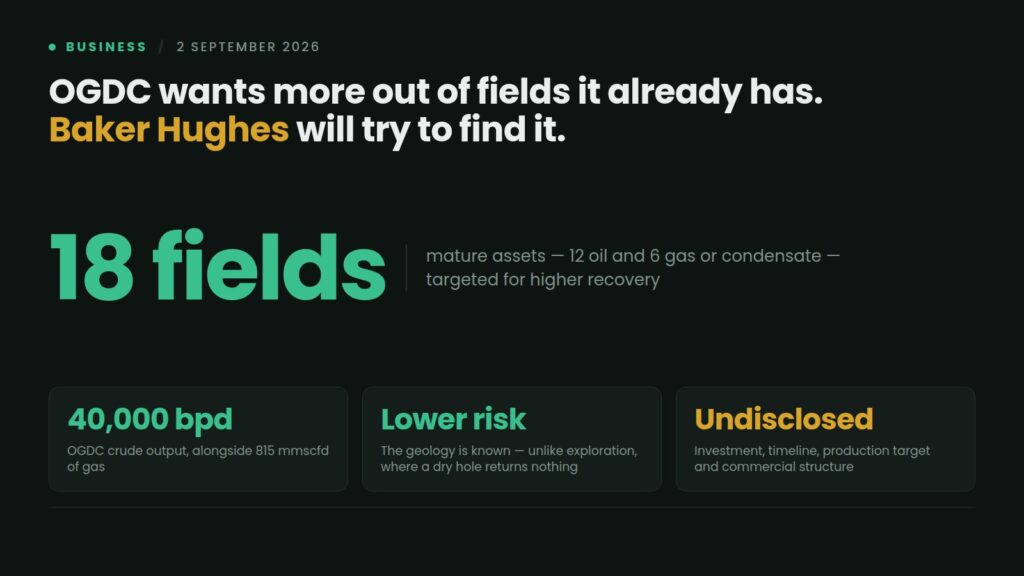
OGDC has signed an agreement with Baker Hughes to apply the US firm’s mature asset solutions across 18 ageing fields — 12 oil and 6 gas or condensate — in an effort to recover more from wells whose production has naturally declined.
OGDC currently produces over 40,000 barrels of crude a day, 815 million standard cubic feet of gas, 780 tonnes of LPG and 80 tonnes of sulphur.
No investment figure, timeline or production target has been disclosed. The strategic logic is clearer than the commercial detail.
Why mature fields are the right target
Every oil and gas field declines. Pressure falls, water encroaches, and the easy hydrocarbons come out first — typically leaving a substantial share of the original resource in the ground when conventional production stops being economic.
Recovering more of that remainder is a technical problem: better reservoir characterisation, artificial lift, water management, workovers, and in some cases enhanced recovery techniques. It is unglamorous engineering and it has one enormous advantage over exploration — the geology is already known.
Exploration is a bet. A dry hole costs the full drilling budget and returns nothing. Extending recovery from a producing field carries far lower risk, because the reservoir has already proved it contains hydrocarbons and the infrastructure to move them exists.
For a country with reserves of $18.4 billion and no capacity for expensive failures, that risk profile is the argument.
What every barrel is worth to Pakistan
The value is not the oil. It is the foreign exchange.
Pakistan imports the overwhelming majority of the crude it refines and pays for it in dollars. It also spends over $2.5 billion a year importing coal and around $4 billion on edible oil. Every domestic barrel displaces an imported one and keeps the dollars at home.
The gas side matters more still. This week a single delayed LNG cargo took roughly 4,000 megawatts off the national grid, forcing overnight load management three months after the government declared load-shedding over. Domestic gas does not arrive by ship and cannot be late.
OGDC’s 815 mmscfd is a meaningful share of domestic supply. Adding to it addresses precisely the vulnerability that produced this week’s outages.
The American angle is not incidental
A US oilfield services major signing with Pakistan’s state exploration company lands in a specific diplomatic moment.
Pakistan has asked Washington for a $10 billion Bilateral Exchange Stabilisation Support Facility and expects a reply within weeks. Google opened a registered office in Islamabad last month with the US Chargé d’Affaires in attendance. Pakistan’s minerals and energy resources have featured in commercial conversations with Washington.
None of that makes this agreement anything other than a commercial arrangement between an operator and a service provider. It does mean American commercial engagement with Pakistan is broadening at the same time a large financial request sits with the US Treasury — and the question of what Washington receives in return for that facility has still not been answered publicly.
What has not been said
The commercial structure, which determines whether this is significant or ceremonial.
Is Baker Hughes being paid a service fee, or does it take a share of incremental production? A fee arrangement means OGDC carries the cost and the risk. A production-sharing structure means the contractor is paid only on results, which is a far stronger signal that both parties expect the barrels to materialise.
Also absent: what incremental recovery is targeted, over what period, and what capital OGDC will commit. Applying advanced recovery techniques to 18 fields is not a consultancy exercise — it requires equipment, workovers and sustained spending.
OGDC is majority state-owned and listed, so shareholders have a reasonable claim to know.
Why OGDC needs outside help for this
A reasonable question is why a company producing 40,000 barrels a day cannot raise recovery from its own fields without a foreign contractor.
Mature asset recovery is specialised in a way ordinary production is not. It depends on reservoir modelling built from decades of well data, and on equipment and techniques a national operator will use on a handful of fields but which a global services firm deploys across hundreds worldwide. The learning is in the volume, and Pakistan does not have the volume.
There is a governance dimension too. OGDC is a state-owned enterprise, and this month the IMF has been pressing Pakistan to stop awarding contracts directly to state enterprises without competitive bidding — a dispute that has stalled replacement of procurement rules dating from 2004. A state operator buying specialist capability from an international provider is the opposite of that pattern, and worth noting as such.
What would make it clearer is knowing how Baker Hughes was selected.
Worth doing regardless
Pakistan’s energy policy has been dominated by imports — LNG terminals, coal cargoes, refined product — and by the circular debt those imports feed, now at Rs1.675 trillion.
Getting more out of fields the country already owns is the cheapest energy available in foreign exchange terms, and it does not depend on shipping lanes that a regional conflict can close. It is the same argument as domestic coal cutting fuel cost 27 percent, or bio-coal from crop waste undercutting imported coal by 40 to 50 percent.
The agreement is sound. The numbers that would tell us how much it matters have not been published.