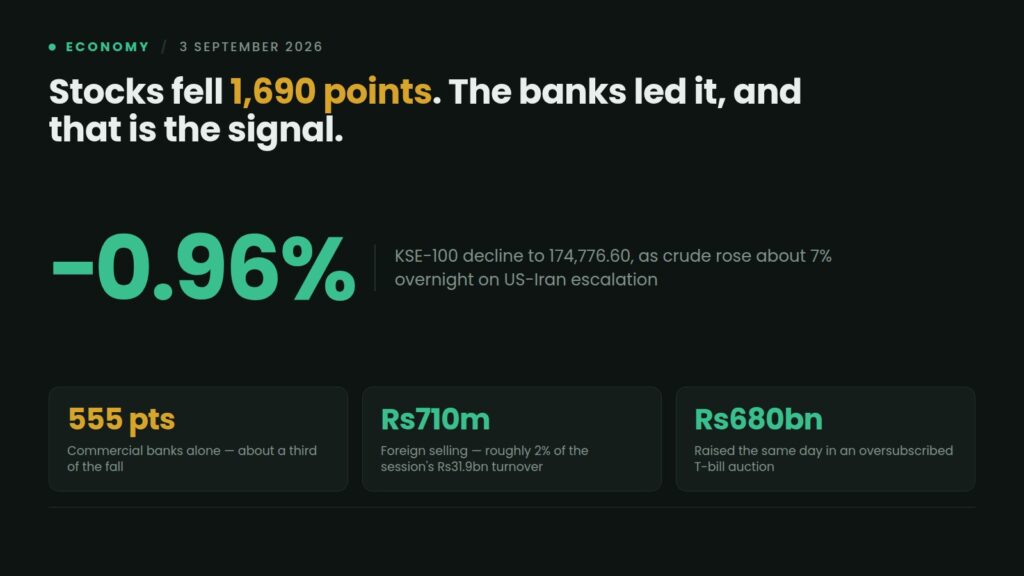
The KSE-100 fell 1,690.40 points to close at 174,776.60 — a drop of 0.96 percent. Crude rose roughly 7 percent overnight on US-Iran escalation and fears about the Strait of Hormuz.
A 1,690-point headline sounds severe. Under one percent does not. Both describe the same session, and the second is the accurate one.
What the index did matters less than what was sold.
Banks took the largest hit
Commercial banks alone accounted for 555 points of the fall — roughly a third of it. Meezan Bank, United Bank and Habib Bank were among the decliners, alongside cement and oil and gas exploration names including Lucky Cement, OGDC and Pakistan Petroleum.
Selling energy stocks on an oil shock is the counterintuitive part, and it is the informative one. Higher crude usually lifts exploration companies. That it did not here says investors were not pricing a commodity move; they were pricing a country.
Banks are the clearest expression of that. A Pakistani bank’s earnings depend on the policy rate, on credit quality, and on the government’s ability to keep servicing the debt that dominates bank balance sheets. Every one of those deteriorates if an oil shock forces inflation up and the State Bank has to reverse course.
That is the fear the session was expressing.
The rate cycle is what is at stake
Almost everything good in Pakistan’s economy this year traces to falling interest rates.
Debt servicing fell about Rs2 trillion, which produced a fiscal deficit of 2.6 percent of GDP — a 22-year low — and the Moody’s upgrade to B3 that followed. SME lending crossed Rs1 trillion for the first time. Auto loans hit a record Rs386 billion. Housing approvals rose 94 percent. Banks moved out of government paper and into lending because the risk-free trade stopped paying.
All of it rests on rates continuing down, or at least not going back up.
Inflation returned to double digits at 11.2 percent in August, driven by fuel and wheat, against a State Bank target of 5 to 7 percent. The policy rate stands at 11.5 percent. A 7 percent overnight move in crude, in a country that imports nearly all of it and taxes petrol at Rs116 a litre, points in exactly one direction.
Selling banks is a bet that the easing cycle is over.
The foreign selling number is small
Foreign investors sold Rs710 million of shares. Against total traded value of Rs31.9 billion, that is roughly two percent of the session.
Foreign participation in the Pakistani market is thin, and that cuts both ways. It means a global risk-off move does not drain the market the way it would in a more internationally held one. It also means the KSE-100 is largely a conversation among domestic institutions and retail investors about domestic conditions.
Volume fell to 610.2 million shares from 784.5 million, with 356 stocks declining against 113 advancing. Broad selling on lower volume is buyers stepping back rather than holders rushing out — a market waiting, not panicking.
Where the index actually sits
174,776 is worth keeping in view. The KSE-100 has run a long way during the stabilisation period, on the same falling rates that drove everything else.
When an index has appreciated substantially on one driver, it becomes sensitive to anything that threatens that driver. A one percent fall from a high level is not a correction. It is a market that has priced in a great deal of good news reacting to the first serious challenge to it.
KTrade Securities expects the market to remain volatile and defensive while elevated oil prices and geopolitical uncertainty persist. That is the right framing — this is not a verdict, it is the beginning of a repricing that depends on events nobody in Karachi controls.
The government still borrowed comfortably
One number from the same day cuts against the gloom. The government raised Rs680 billion through treasury bills, with the auction oversubscribed on strong market liquidity.
That tells you the banking system is not short of money and has no difficulty absorbing government paper. It also hints at where the money sold out of equities went: an investor stepping back from banks and cement on an oil shock does not withdraw the cash, they park it somewhere safer, and treasury bills are the obvious destination.
There is a longer-term concern in that. Banks moving back toward government paper is precisely the trade that falling rates had begun to unwind — the shift that pushed SME credit past Rs1 trillion and auto loans to a record. A rate environment that makes treasury bills attractive again pulls lending away from businesses and households.
What to watch instead of the index
Three things will tell you more than daily point moves.
The next fuel price revision. Petrol is approaching Rs350 a litre. The government has already shown it will negotiate directly with refineries rather than let the formula stand — diesel was cut Rs32.63 that way. What it does at the next revision reveals how much pass-through it will tolerate.
The September inflation print. August was 11.2 percent before this oil move landed.
The next monetary policy decision. If the State Bank holds or raises, the credit expansion that has carried this year’s economy stops — and the banks that led yesterday’s decline will have been right.
Related: Inflation Is Back in Double Digits. Wheat Is Up 87% and Petrol Carries Rs116 in Tax.