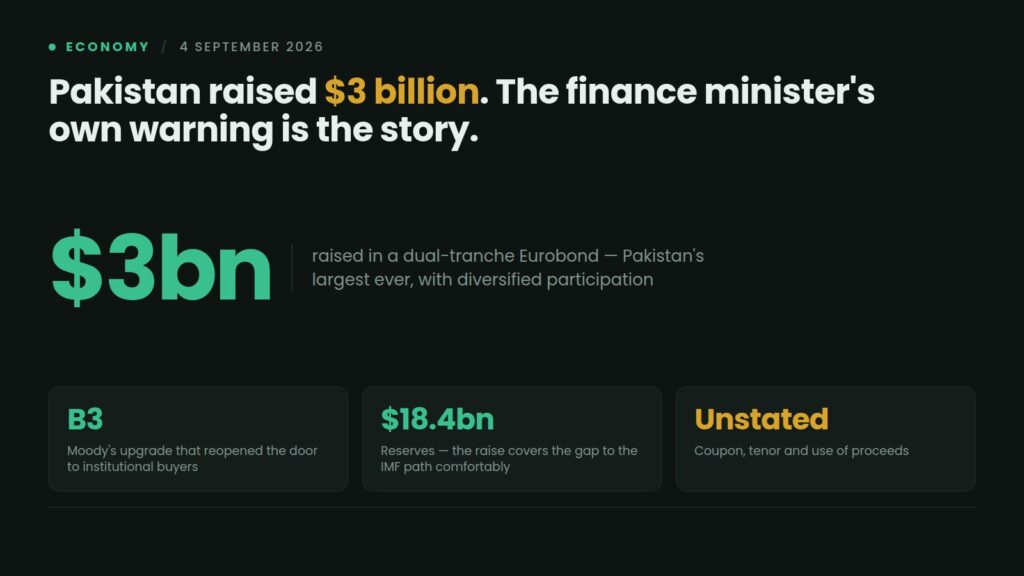
Pakistan has raised $3 billion in a dual-tranche Eurobond — its largest ever — with what the government describes as strong and diversified international participation.
Finance Minister Muhammad Aurangzeb‘s response was not celebration. It was a warning that the framework being built around it should not merely create additional financial structures, but mobilise actual capital and translate it into real investment outcomes.
That is an unusually candid thing for a finance minister to say in the week of a record bond sale, and it is the correct instinct.
Why the market was open
Pakistan spent years locked out of international capital markets. Getting back in required a sequence of things to go right, and most of them did.
Moody’s upgraded the sovereign from Caa1 to B3 with a stable outlook, citing interest payments falling to 35 percent of government revenue from 49 percent and the external vulnerability indicator improving from 230 percent to 145 percent. S&P moved to B in July. The FY26 fiscal deficit came in at 2.6 percent of GDP, a 22-year low.
Caa1 is the tier at which many institutional mandates simply cannot hold the paper. B3 widens the pool of funds permitted to buy — which is precisely what a $3 billion book with diversified participation demonstrates.
The upgrade was the door. This is Pakistan walking through it.
What a Eurobond is and is not
It is borrowing. Dollars raised today against dollars repayable with interest later, and it adds to external debt rather than reducing it.
Whether that is good depends entirely on what the money does. Borrowed dollars that refinance more expensive debt improve the position. Borrowed dollars that build export capacity earn the dollars to repay themselves. Borrowed dollars that fund consumption or plug a reserve gap leave the country with the same problem and a larger obligation.
The size is worth putting in proportion. Reserves stand at $18.4 billion. Moody’s forecasts them reaching only $20 billion by fiscal year-end — about a billion below what has been understood with the IMF. A $3 billion raise closes that kind of gap comfortably.
Which is the useful reading of the minister’s warning: a bond that fills a reserve hole buys time. It does not buy growth.
The private equity framework is the interesting part
Alongside the bond, the government is developing a National Private Equity Policy Framework covering tax neutrality for PE structures, regulatory measures for institutional investors, capital gains treatment on private-company transactions, and valuation methods aligned with international practice.
That list is more technical than it sounds and addresses a real gap. Private equity does not invest where it cannot model an exit, and Pakistan has offered no clarity on how a fund is taxed, how gains on a private sale are treated, or how a company is valued to a standard an international limited partner recognises.
Fixing that is cheap. It requires legislation and regulatory drafting rather than capital.
It also targets the right weakness. Net FDI was $179 million in July, down 20 percent year-on-year, and Moody’s listed minimal foreign direct investment among the structural problems keeping Pakistan seven notches below investment grade. What does arrive goes mostly into power projects under guaranteed-return tariffs or into existing banks — not into growing companies.
The obstacle nobody legislates away
A private equity fund invests rupees and must eventually take dollars out. Everything else is secondary to whether it can.
Pakistan has restricted profit repatriation during past balance-of-payments stress, and investors remember. No amount of tax neutrality compensates for uncertainty about getting capital out at a predictable rate.
Which makes the bond and the framework more connected than they appear. Reserves comfortably above $20 billion, sustained for several years, is what makes repatriation routine — and routine repatriation is what makes a private equity policy worth writing.
Two funding conversations at once
The bond does not sit alone. Pakistan has also asked Washington for a $10 billion Bilateral Exchange Stabilisation Support Facility with maturity of up to five years, and expects a reply within weeks.
The two instruments do different things. A Eurobond raises money the country must repay with interest on a fixed schedule. A standby facility is a backstop that ideally is never drawn, and works by changing how markets price the currency rather than by supplying cash.
Raising $3 billion successfully arguably weakens the case for the facility, since it demonstrates Pakistan can access markets on its own. It may equally strengthen it, by showing there is genuine investor appetite worth protecting.
What has still not been said, in either conversation, is what the United States receives in return for a facility of that size.
What to watch
The pricing. A record size at a punishing yield is a different achievement from a record size at a reasonable one, and the coupon determines what this costs Pakistan for the next decade. It has not been prominently reported.
The use of proceeds. Refinancing expensive existing debt would be the strongest outcome.
And whether the private equity framework reaches legislation. Aurangzeb himself called for moving from policy design toward implementation through a clear and sequenced approach — which is what every Pakistani reform document says, and the reason he had to say it.
Related: Moody’s Upgraded Pakistan to B3. That Is Still Seven Notches Below Investment Grade.