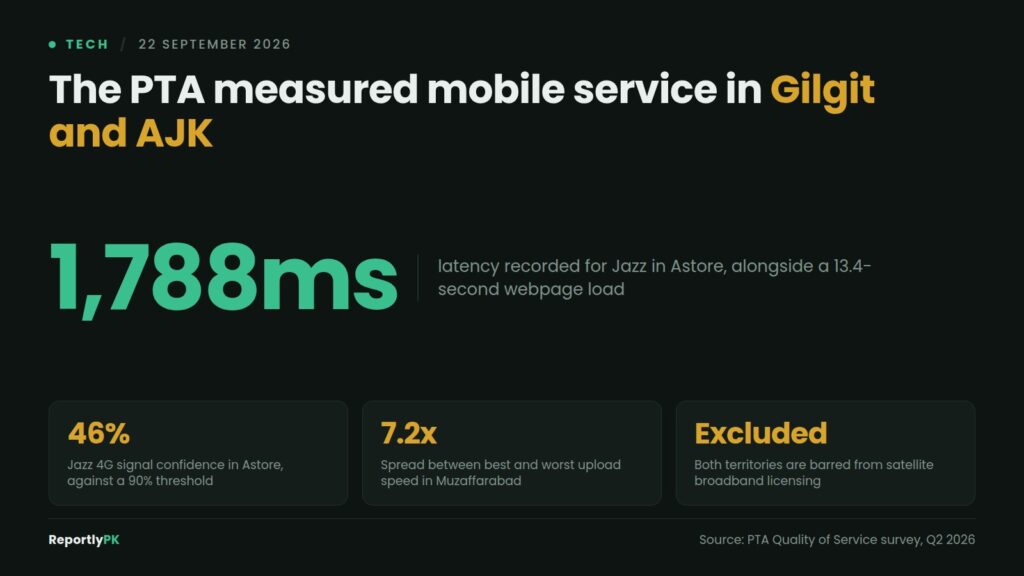
The PTA quality of service survey for Azad Jammu and Kashmir and Gilgit-Baltistan, published on 21 September, tested five mobile networks across six locations. SCOM finished first in every major category. In Astore, Jazz recorded a download speed of 2.9 Mbps, latency of 1,788 milliseconds and a webpage load time of 13.4 seconds.
These are also the two territories Pakistan has written out of its satellite broadband licence.
What was measured
The survey was conducted under the Cellular Mobile Network Quality of Service Regulations 2021 and covered SCOM, Jazz, Telenor, Ufone and Zong. It used roughly 4,100 voice calls and SMS messages and 3,960 mobile broadband samples.
- AJK — Muzaffarabad, Lower and Upper Plate, Assembly Hall Lower Chattar
- Gilgit-Baltistan — Astore, Gorkot, Rattu
Metrics covered voice calls, SMS, download and upload speeds, latency, webpage loading and 4G coverage against a signal-strength confidence threshold of 90 percent.
The state operator won everything
SCOM — the Special Communications Organization, the public-sector operator that exists specifically to serve these two territories — met the 4G signal-strength requirement in all six areas, complied with all thirty voice measures and recorded perfect SMS compliance. Telenor, Ufone and Zong each cleared four of the tested areas on 4G coverage.
On downloads, SCOM posted 43.5 Mbps in Muzaffarabad, 41.5 Mbps at Lower and Upper Plate and 62 Mbps at Assembly Hall. The clean like-for-like comparison is uploads in Muzaffarabad, where all five were measured at the same site:
- SCOM — 21.5 Mbps
- Zong — 19.6 Mbps
- Jazz — 6.4 Mbps
- Ufone — 5.2 Mbps
- Telenor — 3.0 Mbps
A 7.2-fold spread between the best and worst network at a single location, in the regional capital, is not a marginal difference in customer experience. It is the difference between uploading a file and not.
Astore is the number that matters
Jazz is Pakistan’s largest mobile operator by subscribers. In Astore it met the 4G signal-strength threshold with 46 percent confidence against a required 90, and its measured performance follows from that.
Latency of 1,788 milliseconds is about 1.8 seconds of delay before a packet is acknowledged. Interactive video breaks above roughly 150 milliseconds. A 13.4-second page load is what the web felt like on dial-up. And 2.9 Mbps down sits against the 41.5 to 62 Mbps SCOM recorded at its AJK sites — different locations, so not a direct contest, but an indication of what the same handset experiences a few valleys apart.
Jazz also fell below benchmark on SMS at Assembly Hall, at 96 percent against a 99 percent requirement.
The territories written out of the satellite licence
This is where the survey stops being a scorecard and becomes a policy document.
Pakistan finalised its satellite broadband licensing framework in April 2026. Azad Jammu and Kashmir and Gilgit-Baltistan are carved out of the licensed service areas. Four operators — Starlink, Kuiper, Qianfan and one other — are waiting on licences that, when granted, will not permit them to serve either territory.
Astore sits at altitude in terrain where trenching fibre is expensive and maintaining it through winter is harder. It is the textbook case for a satellite terminal: low population density, high cost per kilometre of terrestrial infrastructure, and a terrestrial service that the regulator has just measured and found wanting.
The same state that publishes a survey documenting 1.8-second latency in Astore has prohibited the technology that would fix it there. Both decisions are presumably defensible on their own terms. Together they are difficult to reconcile.
Why the state operator wins
SCOM topping every category is not a story about superior engineering. It is a story about who is required to be there.
A commercial tower in Astore serves a few hundred subscribers across difficult terrain, needs power in a place where grid supply is unreliable, needs backhaul over a mountain, and needs a maintenance crew that can reach it in February. At Pakistani average revenue per user, that site does not pay for itself on any timeframe a listed operator’s board will approve. The rational commercial decision is to cover the town centre adequately, skip the valley, and put the capital into Lahore.
SCOM was created precisely because that calculation produces no service. It operates in AJK and Gilgit-Baltistan under a public-sector mandate rather than a payback period, which is why it clears benchmarks in all six locations while three commercial networks clear four and the largest operator in the country fails one outright.
That is also the argument the survey makes without meaning to. Where the per-site economics cannot work, the options are a subsidised state operator or a technology with no per-site cost at all. Pakistan currently has the first and has forbidden the second.
Credit where it is due
Publishing operator-level results with named failures is good regulatory practice and it is rarer than it should be. Most regulators publish aggregate compliance rates that protect everybody. The PTA named Jazz, gave the location, and printed the number.
That is the mechanism that actually improves service, because a published failure in Astore is a line item in somebody’s quarterly review in Islamabad.
What the survey does not show
Six locations is a spot check, not a coverage map. Roughly 4,100 voice and SMS samples across two territories tells you about six places on the days the testing team was there, and drive-test surveys systematically over-sample roadsides and settlements.
Two further omissions matter. There is no comparison with previous surveys, so nothing here shows whether service is improving or deteriorating. And there is no statement of consequence — nothing indicates what happens to an operator that misses a mandatory benchmark, whether a penalty follows, or by when it must be fixed.
A measurement with no stated remedy is a report card, not a regulation.
Related: Pakistan Wants 8.5% of Satellite Internet Revenue. India Takes 4%.