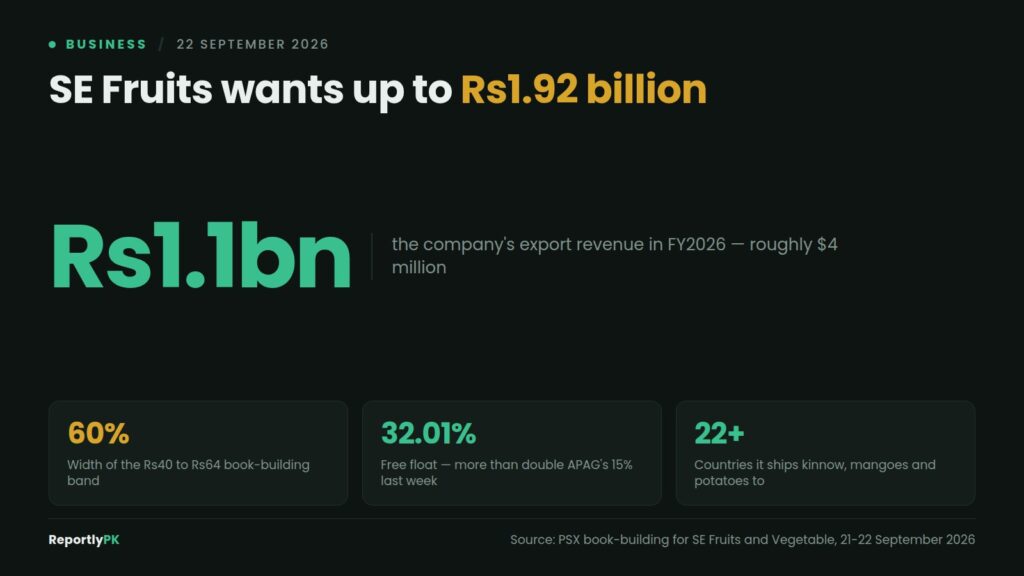
The SE Fruits IPO closed its two-day book-building on the Pakistan Stock Exchange today. The company is offering 30 million shares, or 32.01 percent of post-IPO capital, at a floor of Rs40 with a ceiling of Rs64 — raising between Rs1.20 billion and Rs1.92 billion.
SE Fruits and Vegetable Limited generated roughly $4 million in export revenue in FY2026 — about Rs1.1 billion. The company is raising more than its annual export earnings, and that is the number to start from rather than the number to end on.
What is being sold
The Sargodha-based exporter, formerly Shaheen Enterprises, has nearly three decades of trading history and ships kinnow, mangoes, potatoes and other produce to more than 22 countries.
- 22.5 million shares (75 percent) to institutions through book-building on 21 and 22 September
- 7.5 million shares (25 percent) to the general public on 28 and 29 September
- Joint lead managers: Topline Securities and Growth Securities
Work the float backwards and 30 million shares at 32.01 percent implies about 93.7 million shares outstanding. That values the company at Rs3.75 billion at the floor and Rs6.0 billion at the ceiling.
The multiple, with the caveat that matters
Against Rs1.1 billion of export revenue, the floor valuation is about 3.4 times and the ceiling about 5.4 times.
Now the caveat, and it is a large one. The $4 million figure is export revenue. It is not total revenue. An exporter of this kind almost certainly sells domestically as well, and none of the reporting states what total turnover is or what the company earns after costs.
So those multiples are market capitalisation against one disclosed revenue line, not a valuation. The genuinely useful numbers — total revenue, gross margin, profit after tax, and therefore the price-to-earnings ratio anyone would actually price this on — sit in the prospectus and not in the announcement. A retail investor reading the coverage ahead of the 28 September offering is being given a price range without the denominator.
A 60 percent band, one week after APAG
The Rs40 to Rs64 range is a 60 percent spread between floor and ceiling. That is wide, and the timing makes it interesting.
Eight days ago APAG listed after a book-building exercise with a narrower 40 percent band, from Rs32 to Rs44.80. Its book was covered 1.84 times and it struck at Rs33 — one rupee above the floor. The same institutions being asked to bid on SE Fruits this week are the ones who declined to pay above the floor last week.
Setting a wider premium band into that is either confidence or optimism, and the strike price will say which. Watch where it lands relative to Rs40 rather than whether the book is covered — coverage counts bids, not conviction.
The float is better than the last one
Credit where it is due: 32.01 percent is more than double APAG’s 15 percent free float.
That matters after listing. A third of the company in public hands produces real trading volume, genuine price discovery and a stock an institution can exit without moving the market against itself. Pakistani family groups habitually list the smallest stake the rules permit, and a company offering twice the minimum is making a different bet — that liquidity is worth more than control of the register.
Why the money is being raised
Proceeds go to working capital, larger seasonal procurement and processing throughput. For a fruit exporter this is the correct use of equity, and it is worth explaining why.
A kinnow exporter must buy fruit when the growers harvest it, in a window of a few weeks, and is paid by foreign buyers months later. The gap between those two dates is the entire business, and the size of the cheque you can write at harvest determines how much you can ship. Funding that gap with bank debt at an 11.5 percent policy rate is expensive and seasonal borrowing is exactly what Pakistani banks price worst. Equity does not have to be repaid in March.
The risks specific to this one
Three sit above the usual small-cap concerns.
Seasonality and weather, because a single bad kinnow crop compresses a year. Phytosanitary risk, because an importing country can close its border to Pakistani produce on a plant-health notification with no notice and no appeal, and a business selling into 22 markets can lose one of them overnight. And concentration, because the crops named are a short list.
Against those, the broader point is the encouraging one. This is the second Pakistani IPO in eight days and, on last count, around the thirteenth listing of the calendar year. A market where an agricultural exporter from Sargodha can raise a billion rupees of equity instead of begging a bank for seasonal credit is doing something Pakistan’s capital market has not reliably done for a decade.
Related: APAG’s Book Was Covered 1.84 Times. It Still Priced One Rupee Above the Floor.