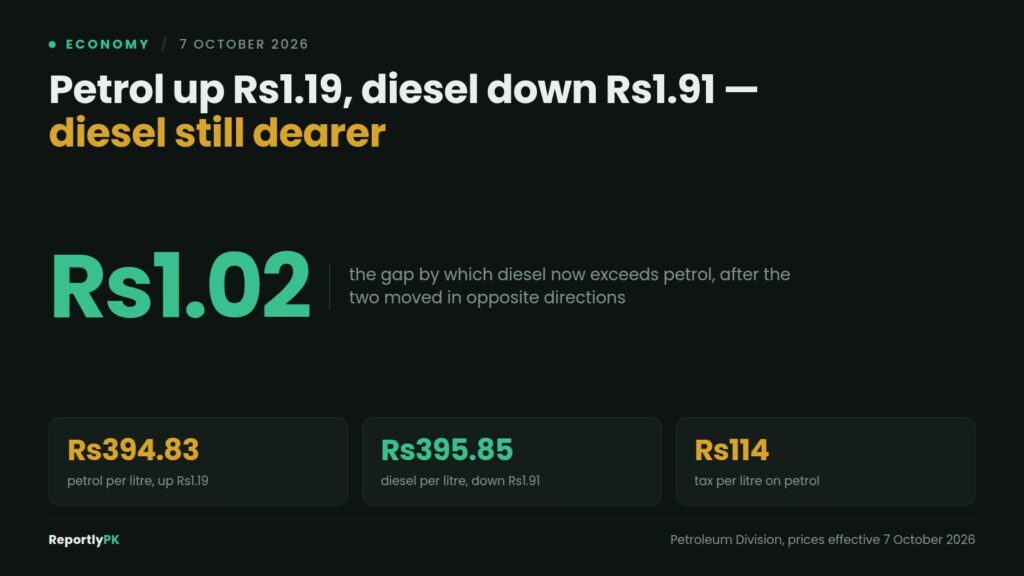
The two fuels moved in opposite directions again. The petrol diesel price revision announced by the Petroleum Division on Tuesday takes petrol up by Rs1.19 to Rs394.83 a litre and brings high-speed diesel down by Rs1.91 to Rs395.85, both effective 7 October.
The result is that diesel still costs more than petrol in Pakistan, but by only Rs1.02 a litre. That gap has been closing, and the mechanism closing it is one most consumers have not yet adjusted to: since 17 July, fuel prices here have been set daily rather than fortnightly.
The new prices
- Petrol: Rs394.83 a litre, up Rs1.19
- High-speed diesel: Rs395.85 a litre, down Rs1.91
- Gap between the two: Rs1.02, with diesel still dearer
- Tax collected on petrol: about Rs114 a litre
- Tax collected on diesel: about Rs100 a litre
- Effective: 7 October 2026
At Rs114 a litre on petrol, roughly 29 percent of what a motorist pays at the pump is tax. On diesel the Rs100 charge is about 25 percent. Neither figure moved in this revision, which is the point worth holding onto: the Rs1.19 and the Rs1.91 are the product and freight components changing, not the state’s take.
Daily pricing changes what a revision means
Under the fortnightly regime that ran for years, each announcement carried two weeks of accumulated international movement, which is why the numbers were large and the political reaction was loud. Daily revision breaks the same movement into small increments.
That has a real effect on how the change is experienced. A Rs1.19 rise reads as trivial. Repeated across a month of rises, it is not. Petrol has now risen on consecutive days, and a run of Rs1-a-day increments compounds to the same place a single fortnightly announcement would have reached — without the single moment at which anyone objects.
It also means the headline number has stopped being a useful summary. What matters now is the direction over a week, and nobody is publishing that as a single figure.
How far prices have already fallen
The current level looks high, and it is, but it sits well below this year’s peak. Diesel reached Rs520.35 on 3 April and petrol Rs458.41 on the same day, at the height of the disruption that followed the outbreak of the US-Iran conflict on 28 February.
Diesel had been at Rs281 before that conflict began. It climbed by about 85 percent to its April peak, and has since given back roughly Rs124 a litre — leaving it around 41 percent above where it started the year. The retreat is real; the recovery is incomplete.
Related: Pakistan’s trade deficit widens 15pc to $10.79bn in Q1 FY27
Why diesel matters more than petrol
Of the two numbers announced, the diesel cut is the one with broader economic reach. Diesel moves freight, runs agricultural machinery and powers much of the backup generation that industry relies on. Its price feeds into the cost of goods rather than only into household transport budgets.
A Rs1.91 cut is small against a Rs395.85 base — under half a percent — so no measurable effect on transported goods prices should be expected from this revision alone. The transmission runs the other way too, and it is slow: diesel cuts tend to reach consumer prices later and less completely than diesel increases do.
Inflation came in at 10.3 percent in September, and energy costs are among the components that have kept it in double digits. A fractional diesel cut does not change that arithmetic.
The diesel-petrol inversion is unusual
For most of the past decade petrol was the dearer of the two fuels at Pakistani pumps, and the ordering was taken as fixed. It is not fixed now. Diesel sits above petrol, and this revision narrowed the gap to Rs1.02 rather than restoring the old order.
Two things drive the inversion. The tax wedge is larger on petrol — about Rs114 a litre against Rs100 on diesel — which pushes petrol up relative to diesel at the pump. Working the other way, international middle-distillate cracks have run ahead of gasoline cracks through this year’s supply disruption, which pushes the underlying diesel cost up faster.
When the second effect outweighs the first, diesel ends up dearer despite carrying less tax. That is where the market has been, and a Rs1.02 spread means it would take only a day or two of divergent movement to flip the ordering again. Under daily revisions, that is no longer a notable event.
The austerity measures are still running
Measures introduced in response to this year’s fuel volatility remain in place, including 9pm market closures and a 50 percent cut in fuel allocations for official vehicles over a three-month period.
No figure has been published for what either measure has saved, which makes their continuation hard to assess. Market closure hours carry a cost in retail trade that is also unquantified. Both were introduced when diesel was near Rs520; neither has been revisited publicly now that it is near Rs396.
That is the question this revision raises rather than answers. If the austerity package was a response to a price shock, and the shock has partly reversed, the case for keeping it should be restated on the current numbers — and so far it has not been.