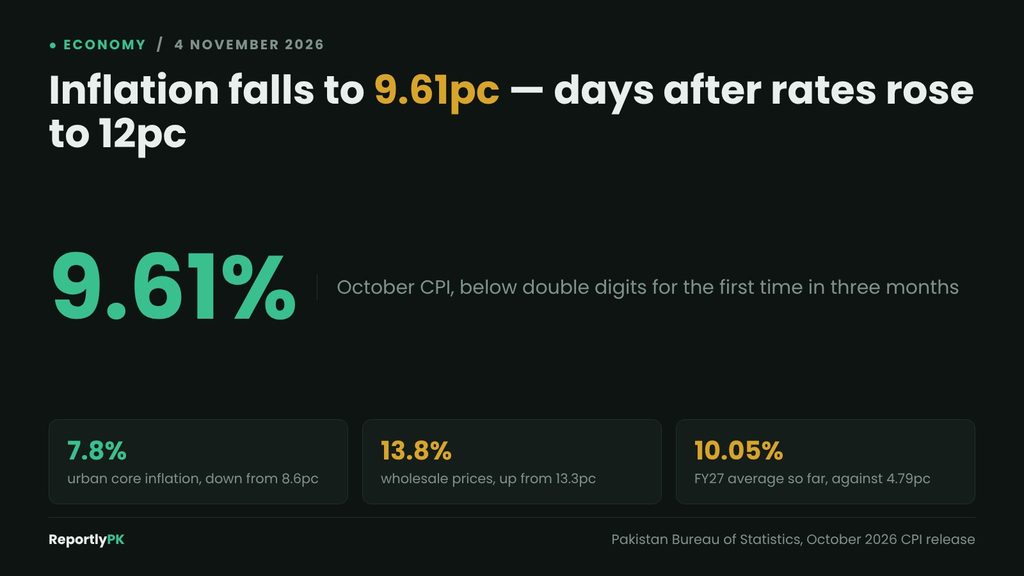
Pakistan inflation fell to 9.61 percent in October, back below double digits for the first time in three months and down from 10.3 percent in September. The reading landed inside the Finance Division’s projected range of 9.5 to 10.5 percent.
It also landed eight days after the State Bank raised its policy rate by 50 basis points to 12 percent, on a 9-1 vote, citing inflation that had run above the Monetary Policy Committee’s expectations.
The October numbers
- National CPI: 9.6 percent year on year, 1.1 percent on the month
- Urban: 9.5 percent, from 10.1 percent in September
- Rural: 9.8 percent, from 10.5 percent
- Core inflation, urban: 7.8 percent, from 8.6 percent
- Core inflation, rural: 7.1 percent, from 8.1 percent
- FY27 average so far (July-October): 10.05 percent, against 4.79 percent a year earlier
Core inflation falling faster than the headline is the genuinely encouraging part. Core strips out food and energy, so a drop of 0.8 points in urban core suggests the easing is not purely a function of commodity prices reversing.
Two indices moved the other way
The headline fell. Two other measures published in the same release rose.
The Sensitive Price Indicator for the lowest income group rose to 8.7 percent from 8.4 percent. The Wholesale Price Index rose to 13.8 percent from 13.3 percent, leaving wholesale prices running 4.2 points above consumer prices.
Both have implications the headline conceals. An SPI rising while CPI falls means the basket weighted toward the poorest households got more expensive in a month when the average basket got cheaper — the easing is not reaching the bottom of the distribution. And wholesale prices running well ahead of retail is pipeline pressure: costs that distributors and retailers have absorbed but not yet passed on.
Related: IMF puts FY27 inflation at 9.9pc against the government’s 8.2pc target
Wheat is still doing the damage
Among urban food items, the month-on-month moves were severe at the top. Chicken rose 19.38 percent, gram pulses 9.17 percent, wheat 9.01 percent, flour 7.54 percent and eggs 5.72 percent. Tomatoes fell 31.63 percent, onions 4.23 percent, potatoes 4.04 percent and sugar 2.17 percent.
Wheat and flour rising about 9 and 7.5 percent in a single month is the specific pressure the Monetary Policy Committee named when it raised rates, alongside renewed Middle East escalation. It is also why the Prime Minister proposed a Rs4,500 wheat support price in late October and why the Deputy Prime Minister has been chairing meetings on wheat imports.
Rural inflation at 9.8 percent against urban at 9.5 percent, and a rural month-on-month rise of 1.5 percent against 0.8 percent urban, is consistent with that. Food carries more weight in the rural basket, so a wheat shock shows up there first.
Did the State Bank move too early?
The sequence invites the question and the answer is probably no, for reasons worth setting out rather than assuming.
Monetary policy acts with a lag of several quarters, so a rate decision taken in late October was never aimed at the October print. The Committee was explicit that it was acting to stop a supply-side shock feeding into inflation expectations and core prices — that is, to prevent a wheat and energy shock from becoming generalised.
On that test, core inflation falling in both urban and rural baskets is evidence the second-round effects have not taken hold. Whether the hike caused that, or whether it was already underway and the hike was unnecessary, cannot be distinguished from one month of data — eight days is not long enough for a rate change to reach prices.
Transport is the quiet driver
Beneath the food headlines, the largest single year-on-year move in the urban basket was transport, up 30.39 percent. Urban communication rose 15.08 percent, and rural housing, water, electricity, gas and fuels rose 17.62 percent.
A 30 percent rise in transport costs reflects this year’s fuel price trajectory, which saw diesel peak above Rs520 in April after the US-Iran conflict and settle far below that without returning to where it started. Transport feeds into the price of everything that moves, which is part of why wholesale prices are running 4.2 points above consumer prices.
Communication at 15.08 percent is the one most directly attributable to policy rather than to oil. Mobile package prices rose 12 to 22 percent between June 2025 and June 2026 by the telecom regulator’s own measure, and that increase is now showing up in the consumer price index.
The target is still a long way off
Falling below 10 percent is progress against a very recent comparison and not much else. The State Bank’s target range is 5 to 7 percent. At 9.61 percent, headline inflation is more than two points above the top of it.
The four-month FY27 average of 10.05 percent against 4.79 percent in the same months last year is the figure that frames the year. Prices are rising at roughly twice the pace they were, and the government’s full-year target of 8.2 percent now requires the remaining eight months to average well below that.
The IMF’s projection of 9.9 percent for FY27 remains above both the official target and this month’s reading. One month below 10 percent does not settle that disagreement; it makes the next two readings worth watching closely.