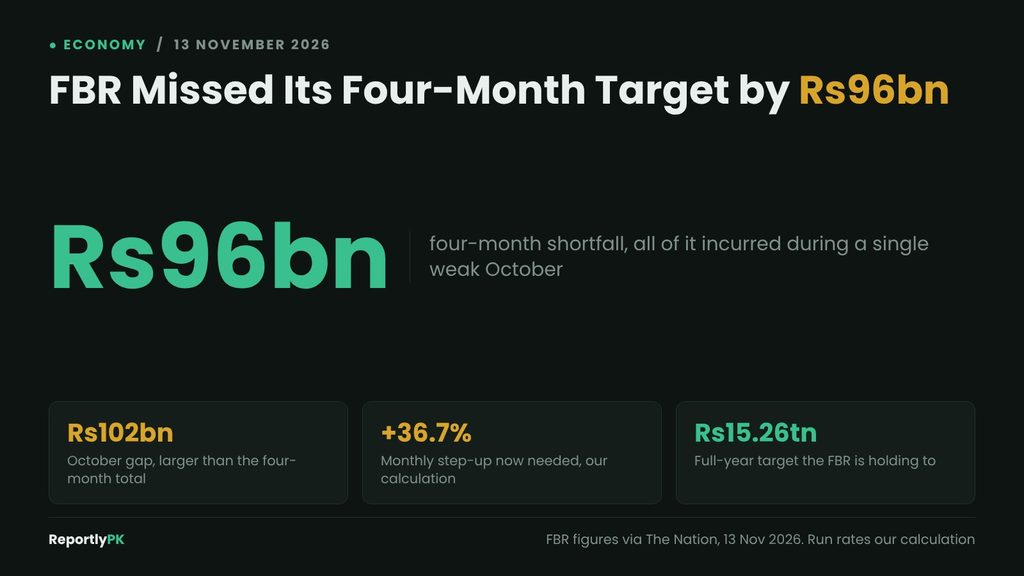
FBR tax collection came in at Rs4.089 trillion over the first four months of FY27, against a target of Rs4.185 trillion, leaving a shortfall of Rs96 billion. The Federal Board of Revenue says it remains confident of hitting the full-year target of Rs15.264 trillion, and points to higher-than-projected inflation as part of the reason. The arithmetic required to get there deserves a closer look than that explanation offers.
The Shortfall Is Entirely October
October collection was Rs1.003 trillion against a monthly target of Rs1.132 trillion, a gap of Rs102 billion. That single month’s shortfall is larger than the cumulative four-month shortfall of Rs96 billion, which means the first quarter actually ran about Rs6 billion ahead of target on our calculation.
This supports the FBR official’s account that collection was on track through September and that October is the anomaly. It also sharpens the question. A gradual drift suggests a target set slightly too high. A single month missing by nine per cent suggests something specific happened, and the composition points to what.
Where the Money Did Not Come From
Three sources are named. Financial institutions paid about Rs30 billion less than expected under the monthly advance tax head in October. Contributions from power distribution companies have been declining. State-owned enterprises also fell short.
None of those is a collection failure in the usual sense of evasion or administrative weakness. Advance tax from banks tracks bank profitability, which has been compressed as the policy rate cycle turned. Disco contributions track electricity sales and recovery rates. SOE payments track SOE performance. All three are the tax system reporting on the economy rather than on itself, and none of them is obviously fixed by enforcement effort.
Related: Pakistan Inflation Climbs to 9.6 Percent in October 2026
What the Annual Target Actually Requires
Four months in, the FBR has collected Rs4.089 trillion of a Rs15.264 trillion target. That is about 26.8 per cent of the year’s revenue with 33.3 per cent of the year gone, by our calculation.
Closing the gap means collecting Rs11.175 trillion across the remaining eight months, or about Rs1.397 trillion a month. The average over the first four months was roughly Rs1.022 trillion a month. That is a required step-up of about 36.7 per cent in the monthly run rate, sustained for two-thirds of the year.
Revenue collection is genuinely back-loaded in Pakistan, with the fourth quarter typically the strongest as advance tax instalments and year-end settlements land, so some step-up is normal and expected. A step-up of more than a third is a larger ask than seasonality alone usually delivers.
The Growth Rate Built Into the Target
FY26 collection was Rs13,010.4 billion, up 10.8 per cent, with direct taxes rising 13.7 per cent and indirect taxes 7.9 per cent. The FY27 target of Rs15.264 trillion implies growth of about 17.3 per cent on our calculation.
So the target asks the revenue machine to grow roughly 60 per cent faster than it managed last year. That is not impossible, and the direct tax trend of 13.7 per cent shows the base is widening. But a target that needs a step change was always going to look stretched after one weak month, and the four-month position is a symptom of how the number was set as much as of how October went.
Relying on Inflation Is an Awkward Defence
The FBR’s stated grounds for optimism include inflation running above projection. Mechanically this is correct. Most of Pakistan’s tax base is nominal, so higher prices lift sales tax, excise and withholding receipts without any change in real activity.
It is still an uncomfortable thing for a revenue authority to be counting on. A nominal target met through inflation is a target met while real collection stands still, and the households paying that sales tax are the ones absorbing the price rises that generate it. It also means the headline achievement, if it comes, will say little about whether the tax base has actually broadened.
The shortfall matters beyond the FBR because of what sits downstream of it. Federal tax revenue is the pool from which provincial transfers under the National Finance Commission award are made, so a federal collection gap propagates into provincial budgets with a lag. Provinces that have planned development spending against projected transfers feel a missed federal target before the federal government does.
It also runs into the primary surplus commitment under the IMF programme. If revenue underperforms and the surplus target holds, the adjustment has to come from expenditure, and development spending is historically the line that absorbs it. That is the mechanism by which a Rs96 billion revenue gap in November becomes a deferred road or a delayed transmission upgrade by spring, and it is the reason a four-month number is worth reading closely rather than waiting for the annual one.
What to Watch
November and December collection will show whether October was a one-month dip or the start of a trend, and bank advance tax is the line to watch, since it was the largest single named miss. If the shortfall widens through the half-year, the question moves from collection performance to whether the target is revised, and a revision mid-year carries fiscal consequences under the IMF programme that a missed month does not.
The FBR has not announced new measures, which is itself informative. Its position rests on seasonality and inflation doing the work. Both may well be enough. Neither is something the authority controls.