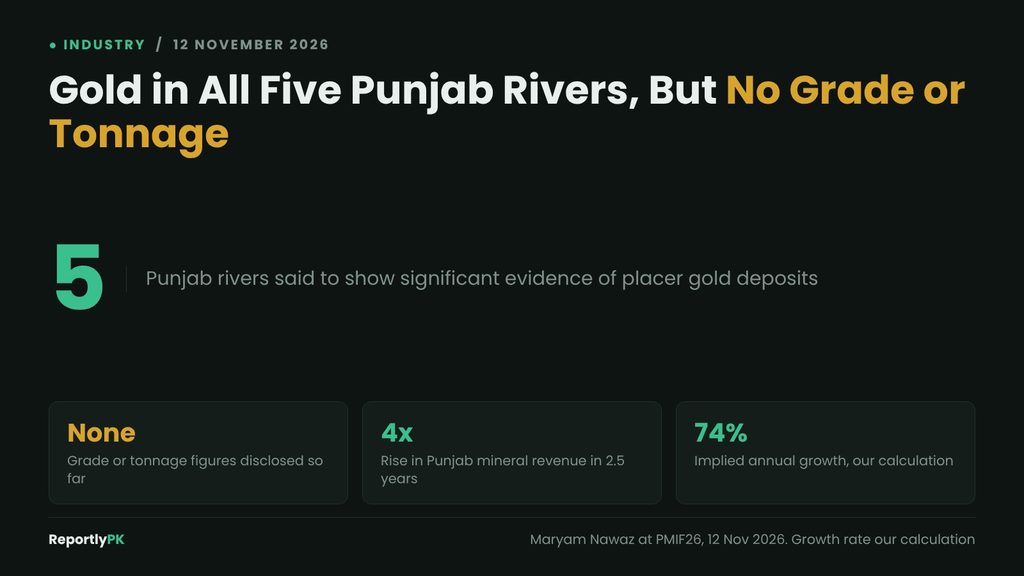
Punjab Chief Minister Maryam Nawaz Sharif told the Pakistan Minerals Investment Forum in Islamabad on Thursday that there is significant evidence of placer gold in all five of the province’s rivers, holding up a sample she said was recovered from river sand. She singled out Mianwali and Attock districts, and said the sand and gravel also contain rare earth and precious minerals that could be worth as much as the gold. Surveys to size the deposits are still under way.
What Was Claimed at PMIF26
The announcement came on the opening day of the two-day forum, organised by the federal government with the Special Investment Facilitation Council. Prime Minister Shehbaz Sharif, Deputy Prime Minister and Foreign Minister Ishaq Dar and Field Marshal Syed Asim Munir are among the speakers, alongside international mining executives including Barrick chairman John L. Thornton and Ivanhoe Mines founder Robert Friedland.
Maryam Nawaz used the platform to invite international investors into Punjab’s mining sector, and cited the provincial Mines and Minerals Department’s revenue rising from Rs10 billion when she took office to Rs40 billion over two and a half years. No quantity, grade or value estimate was given for the gold itself.
Placer Gold Is Real. The Question Is Grade.
The existence of placer gold in the Indus river system is not in dispute and never has been. Gold panning along the Indus in Attock and Mianwali is a documented traditional activity, and the geology is unremarkable: the rivers drain the Himalaya and Karakoram and deposit heavy mineral fractions where the current slows.
The distance between occurrence and deposit is where the economics live. A placer operation is viable or not depending on grade in grammes per cubic metre, the total volume of workable material, the strip and processing ratio, and water and power costs. None of those numbers was offered. A sample held up on a stage establishes that gold is present, which was already known. It does not establish how much, at what concentration, or whether recovering it earns more than it costs.
Related: Reko Diq Production May Slip to 2030 as Capital Cost Reaches $9.1 Billion
The Rare Earth Claim Is the Weaker One
The assertion that accompanying rare earth minerals could be worth as much as the gold needs the most caution of anything said. Rare earth elements do occur in river sands, typically in heavy minerals such as monazite, and detecting them is routine. Detection is not the constraint.
What makes rare earth deposits economic is concentration high enough to justify extraction, and access to separation and refining capacity, which is highly concentrated globally and which Pakistan does not have. Many countries have identified rare earth occurrences in the past decade. Very few have turned them into revenue, and the ones that failed mostly failed at processing rather than at geology. Valuing an unquantified by-product at parity with an unquantified primary product is an investment-forum claim, not a resource statement.
The Revenue Figure, Examined
Punjab’s mineral department revenue going from Rs10 billion to Rs40 billion in two and a half years is a fourfold increase, which works out at roughly 74 per cent compound annual growth on our calculation. That is a genuinely large number and worth taking seriously as evidence of administrative effort.
It should also be read for what it measures. Departmental revenue in a provincial mining sector moves on royalty rates, lease auctions, enforcement against unlicensed extraction and the formalisation of existing informal operators, as much as on new output. Quadrupling collections from a base of Rs10 billion is more plausibly a story about bringing existing activity onto the books than about four times as much rock leaving the ground. That is still a real achievement. It is just a different one from the one the number implies at first glance.
Why the Timing Is Not Accidental
This announcement lands at an investment forum convened to attract foreign mining capital, in the same week that Pakistan’s flagship mining project was reported to be slipping two years. Reko Diq’s first production may move from 2028 to 2030 while its capital cost has risen to about $9.1 billion, with Barrick’s security review extended into 2027.
A new gold prospect in settled, accessible Punjab offers a markedly different risk profile from a copper mine in Chagai, and the contrast will not have been lost on anyone in the room. The presence of the army chief on the speaker list, and the state’s emphasis on providing a security framework for mineral investors, points at the same underlying issue. Pakistan’s mineral problem has rarely been an absence of geology.
What Would Turn This Into News
Three disclosures would move this from announcement to prospect. The first is the survey itself: who is conducting it, to what standard, and when it reports. An assessment prepared to a recognised international reporting code carries weight with financiers in a way that a ministerial statement does not. The second is grade and tonnage, even as a preliminary range. The third is a tendering framework, because placer deposits along populated riverbanks raise water use, agricultural land and local rights questions that are far easier to settle before licences are issued than after.
None of this is a reason to dismiss the finding. Punjab has mineral potential that has been underexplored precisely because attention has gone to Balochistan, and a provincial government pushing for proper survey work is doing something useful. The appropriate response to a gold sample at an investment forum is interest, followed by a request for the numbers.