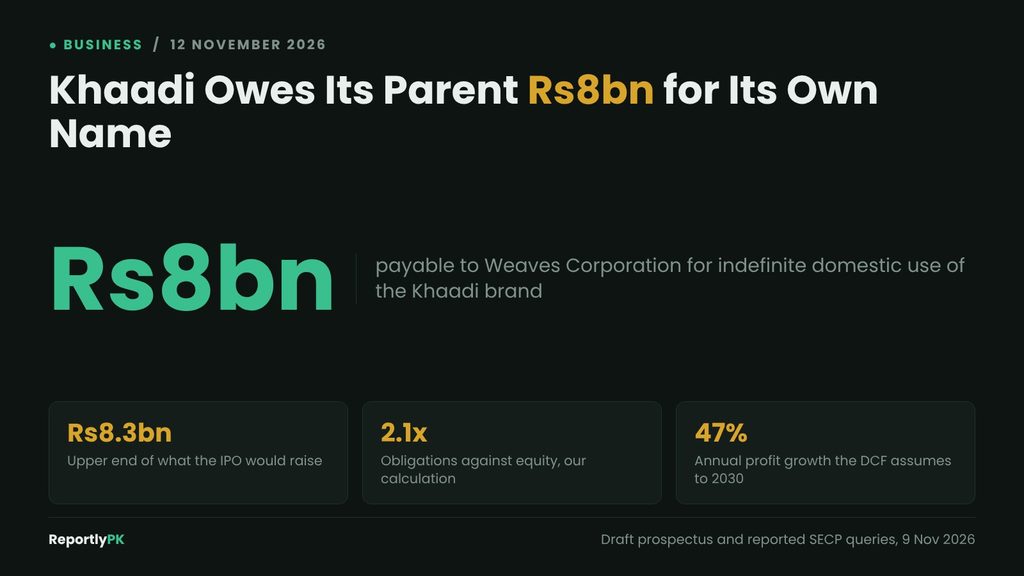
The Khaadi IPO, which would make the fashion retailer the first pure-play clothing company listed in Pakistan, has run into extended questioning from the Securities and Exchange Commission of Pakistan. The regulator has reportedly sought further explanation on the company’s financial statements, its brand valuation, its international operations and its expansion plans. At the centre of the scrutiny sits a single transaction: an Rs8 billion payment owed by Khaadi Pakistan to its own parent for the right to use its own name.
The Offer on the Table
Khaadi Pakistan Limited plans to issue 500 million new shares, 20 per cent of an enlarged capital of 2.5 billion shares. Half go to pre-IPO investors and half to the public, split 175 million through book-building and 75 million to retail. The floor price is Rs12.40 with a book-building ceiling of Rs18, implying a post-listing market capitalisation of Rs31 billion to Rs45 billion and a raise of Rs6.2 billion to Rs8.3 billion. Arif Habib Limited is lead manager and bookrunner, and parent Weaves Corporation would retain 80 per cent.
The business being sold is substantial. Revenue was about Rs25.13 billion in 2025 against Rs24.6 billion in 2024, with gross margin improving from 34 per cent to 36 per cent and reaching about 37 per cent in the first half of 2026. The network covers 31 outlets across 14 cities, with e-commerce reaching more than 200, and operations in the UAE, UK and US. The International Finance Corporation took a minority stake in the group for about $25 million in 2022.
The Rs8 Billion Brand Payment
In 2025 Khaadi Pakistan agreed to pay Weaves Corporation Rs8 billion for exclusive, indefinite domestic use of the Khaadi brand. The regulator is reportedly asking how the intellectual property was valued, what assumptions produced the figure, what role the independent valuer played and on what terms the money is to be paid.
The scale is what makes this more than a technicality. Rs8 billion is between 18 and 26 per cent of the company’s own implied market capitalisation on our calculation, depending on where the book builds. It is also broadly the same size as the entire capital raise. The use of proceeds disclosed so far accounts for about Rs3.1 billion, Rs1.764 billion to repay bridge financing on existing stores and Rs1.336 billion for new Experience Stores in Gujranwala, Sargodha and Islamabad, so the brand payment is not formally earmarked against IPO money. But a listing that raises roughly what the company owes its controlling shareholder is a structure minority investors are entitled to understand fully before subscribing.
Related: SE Fruits IPO Probe Widens as SECP Seeks Records From 30 Banks
Leverage Once the Payable Is Counted
Bank borrowings stood at Rs7.61 billion as at June 2026. Add the Rs8 billion brand payable and combined obligations reach about Rs15.61 billion against shareholders’ equity of roughly Rs7.48 billion. That is obligations at about 2.1 times equity on our calculation.
Whether that is alarming depends entirely on the settlement terms the SECP is asking about. An Rs8 billion liability payable over a decade on soft terms to a parent that controls 80 per cent of the equity is a very different risk from one payable on demand. Neither has been disclosed publicly, which is precisely the gap the questioning appears aimed at.
Two Large Offsetting Entries
The accounts contain a pair of items that deserve explanation. A change of accounting policy to fair-value measurement produced Rs3.32 billion in investment-property revaluation gains. In the same period there were Rs3.21 billion in fixed-asset write-offs, almost exactly cancelling the gain. The 2024 accounts were also restated.
Disclosed 2025 net profit is about Rs1.67 billion, while some reports refer to an underlying loss of roughly Rs1.5 billion. Those two figures can be reconciled by removing the revaluation gain alone, since Rs1.67 billion less Rs3.32 billion gives about negative Rs1.65 billion. They cannot be reconciled by removing both the gain and the write-off, because the two largely offset and the net effect of the pair is only about Rs110 million. We have set out the arithmetic rather than adopt either characterisation, because which adjustment is correct depends on where the write-offs sit in the accounts, and that is not public. It is a reasonable thing for a regulator to want settled before retail investors are invited in.
The Valuation Argument
A discounted cash flow assessment circulating with the offer puts fair value at about Rs28.16 a share, well above the Rs12.40 to Rs18 range. On its face the stock is being offered at 44 to 64 per cent of appraised value, which is our calculation and which sounds like a bargain.
The assumptions do the work, and they are demanding. Projections show revenue reaching Rs77.57 billion and net profit about Rs11.47 billion by 2030, from Rs25.13 billion and Rs1.67 billion in 2025. That is compound annual growth of roughly 25 per cent in revenue and 47 per cent in profit over five years on our calculation, for a domestic apparel retailer converting existing outlets rather than opening many new ones. A discount to a valuation built on those numbers is not necessarily a discount at all.
Why the Scrutiny Is Not Surprising
Context matters here. The SECP halted the SE Fruits offering at the subscription stage last month, ordered refunds and then opened an investigation reaching into thirty banks. A regulator that has just been embarrassed by one listing is going to read the next prospectus closely, and Khaadi is a far larger and more visible offer.
None of this implies wrongdoing. Related-party brand licensing is common in family-controlled groups, revaluation policy changes are permitted, and Khaadi has an operating record and margins most Pakistani listings cannot match. The questions being asked are the right ones, and answering them on the record would strengthen the offer rather than weaken it. For a market that has seen one IPO collapse in a month, a listing that survives this level of scrutiny would be worth more than one that avoided it.