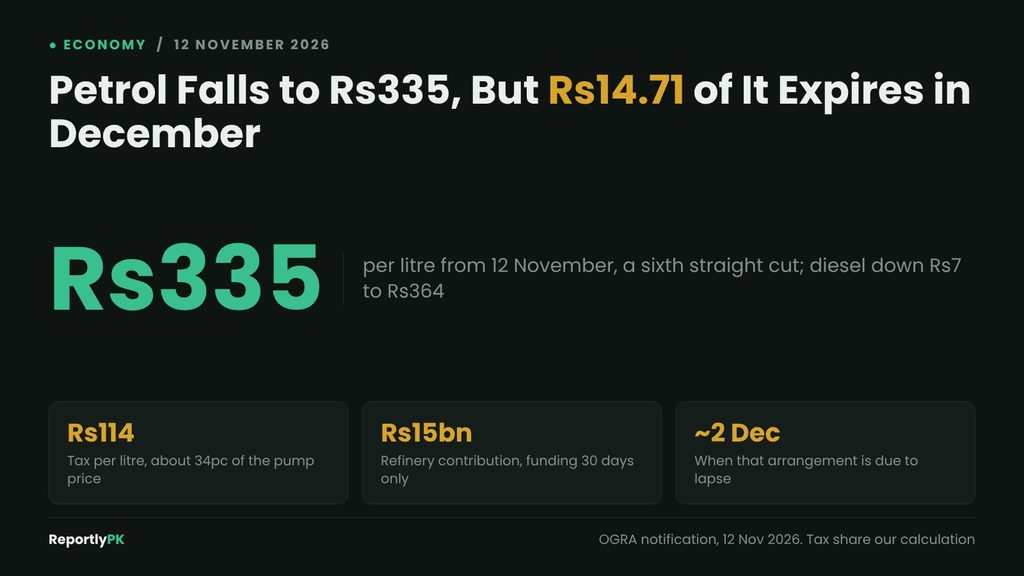
The petrol price in Pakistan fell to Rs335 a litre from Thursday, down Rs3, while high-speed diesel dropped Rs7 to Rs364. It is the sixth consecutive reduction, and over five days petrol has come down Rs11 from the Rs346 in force on 7 November. The relief is real, but the arithmetic underneath it deserves more attention than the headline: a large part of the recent fall is not a tax cut at all. It is a 30-day arrangement funded by oil refineries, and it expires.
The Numbers From Thursday
Petrol stands at Rs335 a litre and high-speed diesel at Rs364. On 11 November petrol was Rs338 and diesel Rs371, both down from Rs346 and Rs378 respectively on 7 November. Across those five days petrol has fallen about 3.2 per cent and diesel about 3.7 per cent on our calculation.
It is worth clearing up a common misreading. These are not out-of-cycle interventions. OGRA has revised ex-depot prices daily since 17 July, tracking international markets, so frequent small moves are now the mechanism rather than an exception. Brent closed at $92.09 on 11 November, slightly lower on the day, which is consistent with the direction of travel.
A Third of the Pump Price Is Tax
Taxes and duties account for Rs114 a litre on petrol and Rs100 on diesel. Against the new prices that is about 34 per cent of the petrol pump price and roughly 27.5 per cent of diesel, by our calculation. Strip the levies out and petrol costs around Rs221 a litre, diesel about Rs264.
This is the structural fact that no amount of daily repricing changes. International crude movements shift the Rs221; the Rs114 stays where fiscal policy puts it. Which is precisely why the political argument has moved from the price to the levy.
Related: LPG Price in Pakistan Hits Record Rs294 as Open Market Charges Double
The Rs15 Billion Clock
Under an arrangement dated 2 November, oil refineries agreed to contribute a combined Rs15 billion towards the petroleum levy for 30 days, which funded a Rs14.71 per litre reduction in the petrol price. That is a transfer from refinery margins to motorists, with a defined end date, rather than a change to the levy itself.
The scale fits the purpose almost exactly. Rs15 billion over 30 days is Rs500 million a day, which at Rs14.71 a litre covers roughly 34 million litres daily, or about one billion litres over the month. That is close to Pakistan’s actual monthly petrol consumption. The sum, in other words, appears calibrated to fund precisely one month of the cut on petrol alone, which is our calculation from the published figures rather than a stated design.
The implication is straightforward. Around 2 December the arrangement lapses, and unless it is renewed or replaced with an actual levy reduction, Rs14.71 a litre comes back into the pump price regardless of what crude does.
What Jamaat-e-Islami Is Demanding
Jamaat-e-Islami chief Hafiz Naeemur Rehman said after Wednesday’s round that the government has agreed to consider a phased reduction in the levy, and that nine to ten rounds of talks have taken place. He accused the government of using the IMF programme as a reason to defer a decision, and said JI has submitted a final draft with technical proposals.
- Extend the relief scheme from vehicles up to 800cc to those up to 1,300cc
- Cover farmers with tractors, public transport operators and motorcyclists
- Raise levies and import duties on vehicles above 1,800cc
- Bar officials from using vehicles above 1,300cc
The party has rallies scheduled in Quetta on 22 November and at Minar-e-Pakistan in Lahore on 29 November, and says it will continue protesting until the levy is abolished. It postponed a march on Islamabad in September at the prime minister’s request.
One Opposition Figure That Needs Care
Hafiz Naeem said the government collects about Rs150 billion a month in petroleum levy while returning only Rs26 billion to Rs30 billion in relief, which would mean roughly 17 to 20 per cent flowing back on our calculation. The ratio is the heart of his case and it is a fair question to put.
The collection figure, though, should be treated with caution. Rs150 billion a month annualises to about Rs1.8 trillion, which sits above the petroleum levy collection in recent federal budgets. JI is a party in an active negotiation and has an interest in the largest defensible number. We have reported the claim because it is central to the dispute, and flagged the arithmetic because readers should not take it as an audited figure.
Where This Leaves Motorists
Prices are well off their peak. Petrol hit Rs458.41 and diesel Rs520.35 on 3 April, so the current levels are about 27 per cent and 30 per cent below those highs respectively, by our calculation. Six consecutive cuts in a softening crude market is a genuine improvement for households and for freight costs that feed into food prices.
The caution is about what is doing the work. Falling crude and a temporary refinery contribution are both reversible, and only one of them is within anyone’s control. A phased levy reduction would be the durable version of this relief, and that is the thing still unagreed after ten rounds. Early December is when the difference between the two becomes visible at the pump.