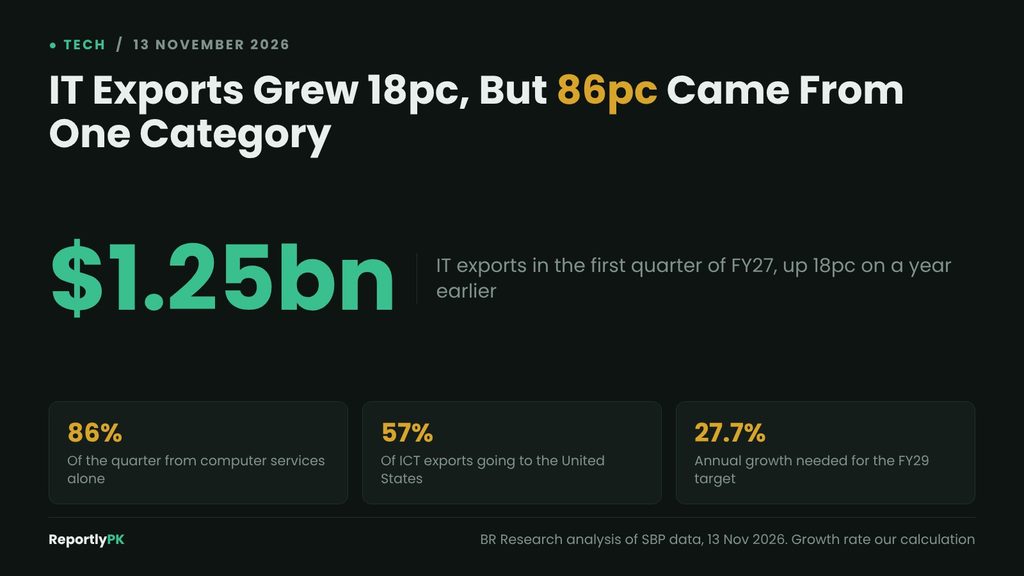
Pakistan IT exports reached $1.25 billion in the first quarter of FY27, up 18 per cent from $1.06 billion a year earlier, with trailing twelve-month exports now around $4.8 billion against $4 billion at the same point last year. The growth is real and it is accelerating. What the headline figure conceals is how narrow it is: 86 per cent of the quarter came from a single category, more than half from two activities, and 57 per cent from one country.
The Quarter in Numbers
Monthly exports stayed above $390 million in each of the first three months of FY27. September alone brought in $435 million, up 19 per cent year on year and 10 per cent on August, the highest monthly figure in nine months, though part of that monthly jump reflected a larger number of working days rather than underlying demand.
Annualising the quarter gives about $5 billion, slightly ahead of the trailing twelve-month figure, which is consistent with a sector still picking up pace rather than plateauing.
Related: NCCIA Raids on IT Firms Put Record Exports at Risk, Says P@SHA
What the Growth Is Made Of
Computer services accounted for about 86 per cent of first-quarter exports, or $1.07 billion. Within that, software consultancy and freelancing together made up close to 56 per cent of total ICT exports, with each growing more than 20 per cent. Freelancing alone rose 32 per cent year on year in September, the fastest-growing component in the mix. Telecommunications services contributed $177 million for the quarter, with call centre exports up 24 per cent.
- Computer services: about 86 per cent of 1QFY27 exports
- Software consultancy and freelancing: close to 56 per cent of ICT exports
- Freelancing growth in September: 32 per cent year on year
- Telecommunications services: $177 million for the quarter
This composition is the part worth sitting with. Consultancy and freelancing are billed time. They earn foreign exchange, they employ people and they require no port, but they do not accumulate into anything. A freelancer who doubles their rate has doubled their income; they have not built a company, a product or an asset that outlives the contract.
Why Freelancing Growth Cuts Both Ways
The 32 per cent growth in freelance earnings is genuinely good news for household incomes and for the balance of payments. It is also the segment with the least institutional durability. Freelance revenue is individual revenue. It generates no intellectual property owned in Pakistan, no corporate balance sheet, no R&D budget and very little tax.
There is a version of the $10 billion export target that is met mostly by more people freelancing for more hours, and a version met by Pakistani firms selling products they own. Both reach the same number. They produce entirely different economies, and only one of them is resilient to a client deciding to hire somewhere cheaper.
The Concentration Is Easing at the Margin
The United States took about 57 per cent of ICT exports in the first quarter, followed by the UAE, the UK, Ireland and Singapore. US exports were $2.59 billion in FY26, nearly double the $1.3 billion of FY21.
But the five-year rates tell a more encouraging story than the share does. US exports grew at roughly 14.8 per cent compounded annually over that period on our calculation, while UAE exports went from $152 million to $536 million, about 28.7 per cent compounded. The second market is growing at nearly twice the rate of the first. Diversification is happening, just from a base too small to move the headline share yet.
What AI Does to This Mix
The uncomfortable overlap is between what Pakistan sells and what automation is best at absorbing. Routine programming, outsourced development and call centre work are precisely the categories where AI tooling is already compressing hours per task, and they are precisely the categories carrying this growth.
That is not a prediction of collapse. The same technology opens work in automation, data analytics and applied AI development, and a workforce that can already deliver to US clients is well placed to move up. But moving up is a decision firms make, not something that happens to a sector. The segments most exposed are the ones currently performing best, which is an awkward place to be reading a strong quarter from.
The telecommunications line deserves a note of its own. At $177 million for the quarter it is the smaller part of the total, but call centre exports within it grew 24 per cent, and that is the segment where the gap between revenue and value added is widest. Voice support work is won almost entirely on cost, carries thin margins and transfers no capability to the provider beyond the headcount it employs.
It is also the segment currently drawing enforcement attention, after the software association complained about cyber crime raids that it says fail to distinguish legitimate call centres from fraud operations. A category growing at 24 per cent while its operators report being raided without warrants is not a stable foundation, whatever the export number says.
The Target, Recalculated
Uraan Pakistan targets $10 billion in annual IT exports by FY29. From the trailing twelve-month base of $4.8 billion, that needs roughly 27.7 per cent compound annual growth over three years, on our calculation. The sector is currently running at 18 to 20 per cent.
The gap has narrowed, which is worth saying plainly: on the FY26 base of $4.6 billion the required rate was closer to 29.5 per cent, so a strong quarter has taken nearly two percentage points off the climb. It remains a target that assumes the sector grows half again as fast as it is managing now, in the same years that AI reshapes the work and the US concentration remains above half. Reaching it is possible. Reaching it on consultancy hours alone is not.