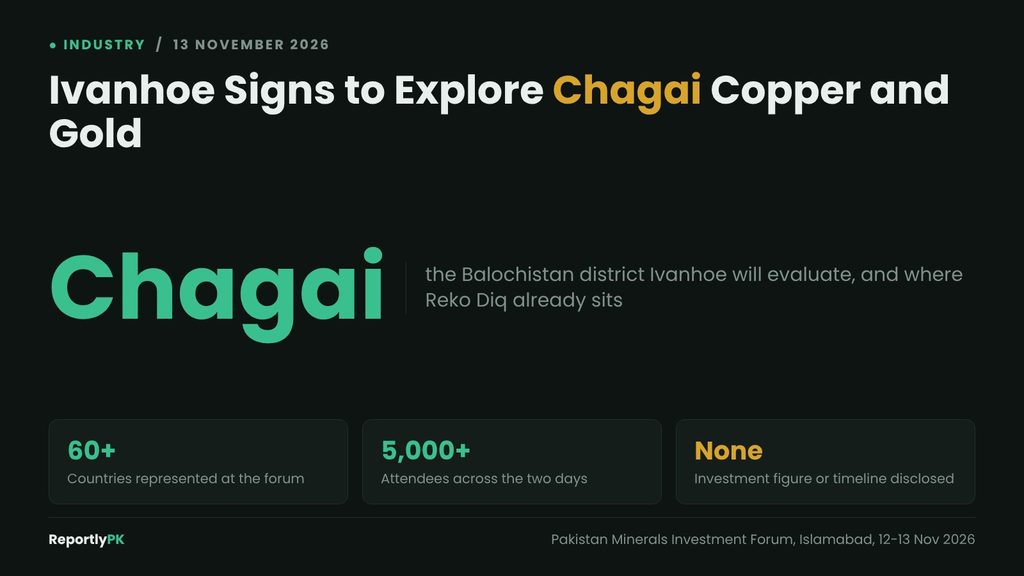
Ivanhoe Mines has signed an agreement with Mari Minerals to explore copper and gold deposits in Chagai, Balochistan, the most substantive outcome of the two-day Pakistan Minerals Investment Forum that closed in Islamabad. Ivanhoe is among the most successful copper explorers of the past two decades, and Chagai is the district that already hosts Reko Diq. The agreement is for exploration and evaluation, not development, and that distinction matters more than the headlines around it suggest.
What Was Actually Signed
The memorandum commits Ivanhoe Mines and Mari Minerals to jointly evaluate the mineral potential of the Chagai region and identify development opportunities in copper and gold. Petroleum Minister Ali Pervaiz Malik witnessed the signing. No investment figure, work programme, licence area or timeline was announced.
That is normal for a document of this kind and it is worth being clear about what it does and does not establish. An exploration MoU is an agreement to spend money finding out whether there is something worth mining. The overwhelming majority of exploration programmes worldwide do not end in a mine. What makes this one notable is not the paperwork but who signed it.
Why Ivanhoe Signing Is the Story
Robert Friedland, who led the Ivanhoe delegation, built the company behind the Kamoa-Kakula discovery in the Democratic Republic of Congo, now one of the largest and highest-grade copper operations in the world. Ivanhoe’s record is in finding tier-one deposits in jurisdictions that most Western mining capital treats as too difficult.
That is the relevant signal. A company with that specific history putting exploration staff into Chagai is a different proposition from a generalist investor signing a courtesy document at a forum. It does not guarantee a discovery. It does mean the geology was assessed by people who are good at assessing geology, and that they concluded it was worth looking.
Related: Reko Diq Production May Slip to 2030 as Capital Cost Reaches $9.1 Billion
The Awkward Context in the Same District
Chagai is where Reko Diq sits, and Reko Diq is not having a straightforward year. Barrick has extended a security review into 2027, capital costs have risen to about $9.1 billion from roughly $7 billion, and first production may slip from 2028 to 2030. Barrick chairman John Thornton was in Islamabad this week and met the petroleum minister, saying the company remains interested in the sector.
So the government has secured a new exploration commitment in the same district where its flagship project is slowing for security reasons. Both things are true simultaneously and neither cancels the other. Exploration carries far smaller capital exposure than construction, which is precisely why a company might commit to one in conditions that make it cautious about the other.
What the Provinces Brought
The forum drew more than 5,000 attendees from over 60 countries. Deputy Prime Minister Ishaq Dar inaugurated it, citing copper and gold potential along the Tethyan Metallogenic Belt alongside iron ore, chromite, lead, zinc, coal, rock salt, marble and gypsum. Finance Minister Muhammad Aurangzeb used the keynote to stress smooth repatriation of profits and dividends, which is the thing foreign mining capital asks about before geology.
- Balochistan: a separate security division established for the Mineral Corridor
- Sindh: 27 minerals identified, with Thar coal the principal asset
- Khyber Pakhtunkhwa: a one-window facility and a provincial minerals company being set up, with over 100 sites identified and 69 in process
- Punjab: placer gold reported in all five rivers, with surveys under way
Balochistan Chief Minister Mir Sarfraz Bugti’s security division is the most consequential of those announcements, because security is the binding constraint the Reko Diq review has made explicit.
Who Else Was in the Room
Beyond Ivanhoe and Barrick, the petroleum minister met the Scottish engineering group Weir, whose chief executive Andrew Neilson said the company wants to expand beyond its existing work at Reko Diq, and the commodity trader Trafigura, which expressed interest in a zinc-barite project as well as LPG, bonded storage and refining. Türkiye’s Çalık Holding also met the minister.
The Trafigura interest is worth noting for what it is: a trading house looks at offtake and logistics, not at building mines. Interest from traders tends to arrive before production and is a reasonable indicator that someone expects volume eventually, though it commits nobody to financing the hole in the ground.
The structure of the agreement is as interesting as the parties. Pairing a foreign explorer with a domestic partner is the arrangement Pakistan has increasingly favoured in extractives, and it addresses two problems at once: the foreign side brings exploration capability and capital tolerance for dry holes, while the local side brings licensing familiarity, ground access and a stake that makes the project politically defensible.
It also spreads the downside. Exploration budgets are written off far more often than they are recovered, and a joint venture means Pakistan is not carrying that risk alone, nor handing the entire upside away if something is found.
How to Judge This in a Year
Mineral forums generate memoranda reliably. The measure of this one will be whether the Ivanhoe agreement converts into a licensed exploration programme with a drilling budget and reported results, because that is the point at which a company has money at risk rather than a signature on a page.
Two other markers are worth tracking. Whether Balochistan’s Mineral Corridor security division is staffed and funded rather than announced, and whether the repatriation assurances Aurangzeb gave are tested by an actual dividend leaving the country. Pakistan’s difficulty in minerals has rarely been attracting initial interest. It has been converting interest into committed capital, and an exploration MoU is a step along that path rather than evidence of arrival.