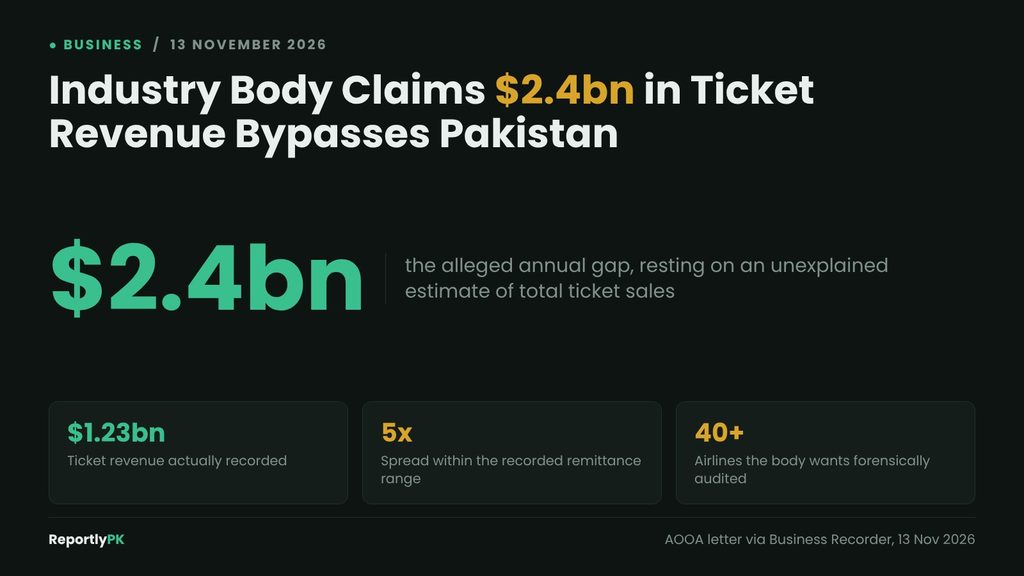
An industry body has asked the finance ministry to commission forensic audits of every airline operating in Pakistan, alleging that roughly $2.4 billion in annual airline ticket revenue is settled offshore and never passes through the country’s financial system. The Aircraft Owners and Operators Association says ticket sales are routed through foreign payment gateways largely invisible to tax authorities. It is a serious allegation, and it comes with no documentary evidence attached.
What Is Being Alleged
In a letter to the Federal Minister for Finance and Revenue, AOOA founder Imran Aslam Khan asked for urgent intervention. The association wants the top three audit firms engaged to conduct separate forensic audits of passenger and sales taxes paid by all airlines over five years, and the resulting shortfall recovered.
Between 40 and 42 scheduled airlines operate in Pakistan, four domestic and the rest foreign. The letter says foreign carriers take close to two-thirds of international ticket revenue. The association frames its points as questions for regulators rather than findings, which is a reasonable way to raise a concern and also a reason to read the numbers carefully.
How the $2.4 Billion Is Built
The calculation subtracts recorded flows from an estimate of total sales. Annual ticket sales for Pakistan-linked travel are put at $3.2 billion to $3.6 billion. Against that, PIA records about $750 million, other domestic carriers about $65 million, and officially recorded foreign remittances $80 million to $411 million, giving a recorded total of about $1.226 billion. The residual is $2 billion to $2.4 billion.
The subtraction is internally consistent, and in one respect conservative: the association uses the upper bound of recorded flows, which produces a smaller gap than the lower bound would. But the entire figure rests on the $3.2 billion to $3.6 billion estimate of total sales, and no method is given for how that was derived. Change the denominator and the headline changes with it.
One detail in the association’s own figures is telling. Officially recorded foreign remittances are given as a range from $80 million to $411 million, a spread of more than five times. A gap that wide in the recorded data is itself the clearest evidence in the letter that nobody has a reliable picture, which is an argument for better reporting before it is an argument for recovery.
Related: Pakistan Income Tax Returns Cross 5.77 Million
Why a Revenue Gap Is Not Automatically Evasion
This is the part most coverage will skip. A difference between tickets sold for Pakistani travel and money recorded as entering Pakistan is partly expected by design, not necessarily a sign that anything was hidden.
International air transport is governed by bilateral air services agreements, and most double taxation treaties assign taxing rights over profits from international traffic to the country where the airline is resident, not where the passenger boards. A foreign carrier selling a ticket abroad for a flight departing Karachi is generally not expected to remit that fare to Pakistan or pay Pakistani corporate tax on the profit. Airlines also settle through the IATA clearing system, which nets payments between carriers internationally, so gross ticket value was never going to appear as a matching inbound remittance.
Treating the whole residual as leakage therefore overstates what is recoverable, possibly by a wide margin. That does not make the gap uninteresting. It means the number as presented measures the structure of international aviation at least as much as it measures non-compliance.
The Part of the Complaint That Holds
Strip out the treaty question and something legitimate remains. Pakistan levies specific taxes and duties on air tickets for travel to and from the country, and those are owed regardless of where the airline is resident or where the card was charged. Whether they are being collected in full on offshore-settled sales is a fair question that the FBR should be able to answer.
The association’s procedural proposals are also sensible on their own terms. It wants ticket sales for Pakistani travel restricted to payment gateways regulated by the State Bank, a mechanism for the FBR to collect applicable taxes in real time through those gateways, and electronic transmission of verified passenger and sales data for every flight.
Real-time collection at the point of sale is how several jurisdictions already handle ticket levies, and per-flight passenger data is something aviation authorities collect anyway. These are administrable asks that do not depend on the $2.4 billion figure being right.
Who Is Making the Case
The AOOA represents aircraft owners and operators, and the letter’s emphasis on foreign carriers taking two-thirds of international ticket revenue sits alongside a tax argument. An industry association calling for forensic audits of competitors is raising a public interest point and advancing a commercial one at the same time, and both can be true.
No airline has responded publicly, and neither the FBR nor the State Bank has commented. Until they do, this is one association’s estimate built on an unexplained denominator.
What Would Settle It
The FBR already receives passenger data and collects ticket taxes, so it is in a position to publish what was assessed and collected on international departures over the past five years. That single disclosure would establish whether there is a collection problem without anyone needing to agree on the size of the global ticket market.
A forensic audit of forty airlines is a large undertaking to launch on an estimate. Publishing the collection data first is cheaper, faster and would tell the government whether the audit is warranted. If the numbers show a shortfall, the case for the audit makes itself.