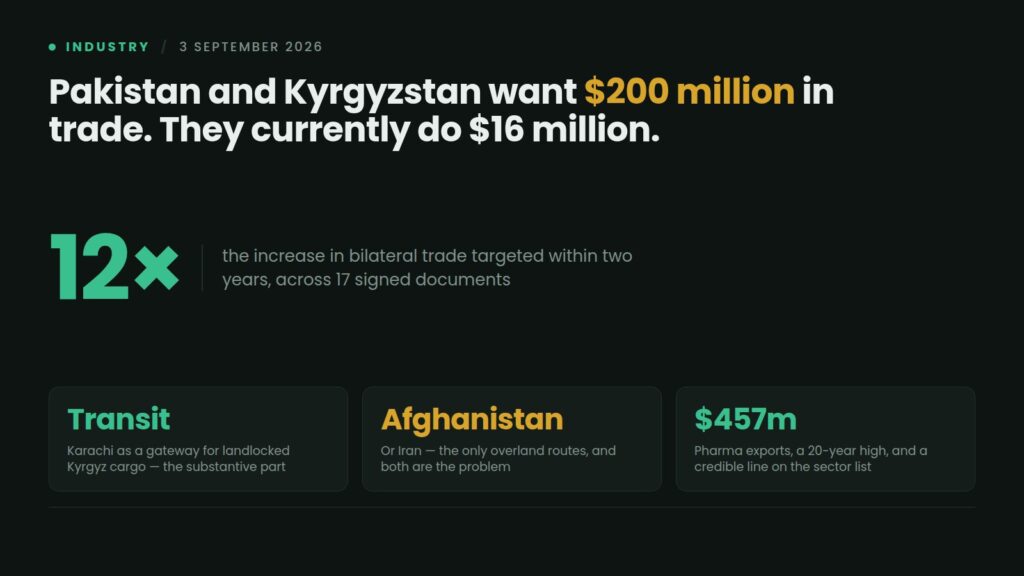
Pakistan and Kyrgyzstan have signed 17 bilateral documents and set a trade target of $200 million within two years.
Bilateral trade currently runs at about $16 million a year.
That is a 12-fold increase in twenty-four months, which puts this in the same category as the pharmaceutical roadmap targeting $10 billion from a $457 million base. The interesting question is not whether the target is realistic but whether the mechanism behind it is.
The base is small enough to make growth easy
$16 million of annual trade between two countries of this size is close to nothing. For comparison, Pakistan’s textile exports alone were $1.81 billion in a single month.
Growing from a base that small is arithmetically far easier than growing an established relationship. A handful of substantial contracts — a pharmaceutical supply arrangement, a few textile orders, one energy transaction — could move the number several times over without either economy changing.
Twelve-fold sounds transformative. On these absolute numbers it is a rounding adjustment to Pakistan’s trade accounts.
The transit agreement is the real content
Buried among the seventeen documents is the one that could matter beyond the headline: a transit trade agreement making Pakistan’s seaports a gateway for Kyrgyz access to global markets.
Kyrgyzstan is landlocked. Its exports currently reach the sea through Russian or Chinese territory. An alternative route south through Pakistan to Karachi and Port Qasim is genuinely valuable to Bishkek — and to Pakistan it is transit revenue: port handling, freight, customs and logistics earnings on cargo that is neither imported nor exported by Pakistan.
That is a better business than most bilateral trade. It earns foreign exchange from geography rather than from production.
It is also the second Central Asian connectivity agreement in two days. Pakistan Railways signed a freight forwarding deal with RZD Logistics on 1 September for container trains to Russia and Central Asia, with Karachi, Faisalabad and Moscow on the route.
Both run into the same wall
Overland freight from Pakistan to Central Asia crosses Afghanistan or Iran. Geography offers no third option.
The RZD pilot train has already been delayed by the regional conflict before carrying a single container. The finance minister warned this week that the US-Iran war threatens Pakistan’s growth and inflation outlook. Crude rose 7 percent overnight and the KSE-100 fell 1,690 points on the same news.
A transit corridor is only worth what its reliability is worth. Cargo does not choose a route that might be closed — it pays a premium for one that will be open.
The domestic leg is not ready either. ML-1 Phase-I, covering the 480km Karachi-Rohri section at $2.5 billion, has just been designated a national priority by the economic affairs ministry and the ADB, with civil work targeted for January 2027 and construction running two and a half to three years after that.
What Pakistan actually has to sell
The sector list — pharmaceuticals and halal products, agriculture and food processing, energy including CASA-1000, textiles and light industry, mining, digital technologies and virtual assets, tourism — is the standard inventory these agreements produce, and most of it will not move.
Two entries are credible. Pharmaceuticals is where Pakistan already exports to markets with lighter regulatory requirements, with exports at a 20-year high of $457 million and Central Asia named in the government’s own roadmap. Textiles is the country’s largest export industry, and Central Asian economies import what it makes.
Digital technologies and virtual assets is the entry to watch with more scepticism, though it connects to something real: PVARA and the State Bank are studying tokenised sovereign bonds, and the agreement links Kyrgyzstan’s Tamchy special financial territory with Pakistani institutions.
CASA-1000 is the one with history
Among the sectors named, the energy entry refers to something concrete and long-running: CASA-1000, the transmission project intended to carry summer hydropower surplus from Kyrgyzstan and Tajikistan south to Afghanistan and Pakistan.
It has been under discussion for well over a decade, and its difficulties are the same ones facing every corridor in this agreement: the line has to cross Afghanistan.
The prize is real. Pakistan lost roughly 4,000MW this week when an LNG cargo arrived late, and imported hydropower is paid for without the shipping dependency that produced those outages. But a transmission line through contested territory carries the same reliability question as a container train through it.
Agreement rather than memorandum
The Prime Minister said he pushed for an agreement instead of a memorandum of understanding, to make the $200 million a concrete commitment.
That distinction is worth something. Pakistan has accumulated a great many memoranda that produced nothing, and insisting on a firmer instrument suggests somebody expects to be held to it.
It does not change what determines the outcome. Two years from now the number will be whatever Pakistani exporters actually sold and whatever cargo actually moved — and the second depends on a corridor that is currently closed and a mainline that is currently a building site.
Related: Pakistan Signed a Freight Rail Deal With Russia. The Pilot Train Cannot Run Yet.