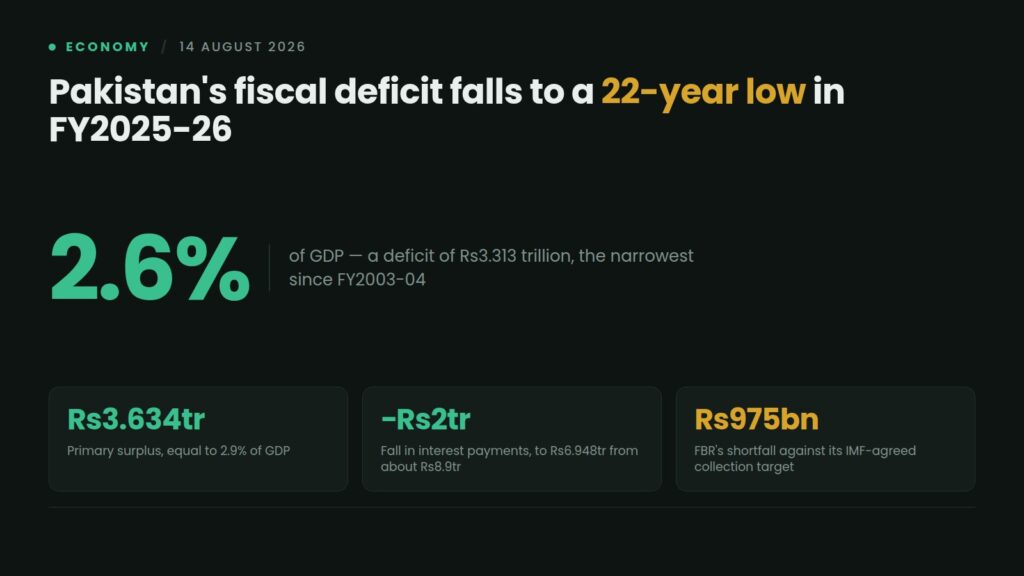
Pakistan closed FY2025-26 with a fiscal deficit of 2.6 percent of GDP — the narrowest gap between what the state earned and what it spent in 22 years.
In rupee terms the deficit was Rs3.313 trillion, against total revenue of Rs19.774 trillion and total expenditure of Rs23.087 trillion. The primary balance — the deficit stripped of interest costs — swung to a surplus of Rs3.634 trillion, or 2.9 percent of GDP.
Those are genuinely strong headline numbers. They are also, on closer reading, less a story about the government collecting more than a story about the government paying less interest.
Where the improvement actually came from
The single largest line item in Pakistan’s budget is debt servicing, and it moved sharply in the government’s favour.
Total mark-up payments came in at Rs6.948 trillion — Rs6.030 trillion on domestic debt and Rs917.217 billion on foreign debt. A year earlier that figure was roughly Rs8.9 trillion. The saving is close to Rs2 trillion in a single year.
Two things produced it. Policy rates fell, which repriced a domestic debt stock that is heavily weighted toward shorter maturities. And the government retired Rs1.9 trillion of domestic debt early, taking the interest bill down with it.
Set the interest saving of about Rs2 trillion against a deficit of Rs3.313 trillion and the arithmetic is hard to miss. Without it, the deficit would look ordinary rather than historic.
Federal current expenditure reflected the same pressure release, falling to Rs14.448 trillion from Rs15.695 trillion the year before.
The revenue side is a weaker story
The Federal Board of Revenue collected Rs13.010 trillion, an increase of about 11 percent year-on-year. It still missed its IMF-agreed target by Rs975 billion.
That gap matters more than the percentage growth does. Nominal GDP grew too, so an 11 percent rise in collection is not obviously a widening of the tax net — and the shortfall is precisely the number the IMF will open with during the fourth Extended Fund Facility review and second Resilience and Sustainability Facility review, both scheduled for next month and covering January to June 2026.
What filled the hole was non-tax revenue of Rs5.554 trillion, and the composition is familiar:
- Rs2.428 trillion — State Bank of Pakistan surplus profit
- Rs1.567 trillion — Petroleum Levy, beating even its revised target of Rs1.498 trillion by Rs69 billion
- Rs157.470 billion — mark-up from public sector enterprises
- Rs131.631 billion — oil and gas royalties
- Rs52.853 billion — natural gas development surcharge
Between them, the central bank’s profit and the levy on fuel account for close to Rs4 trillion — roughly a fifth of all federal and provincial revenue. Neither is a tax on income or profit. The SBP surplus is a function of the same high interest rates that were inflating the debt bill, and the petroleum levy is a consumption charge paid at the pump by every household and every freight operator.
For 2026-27 the levy target has been raised again, to Rs1.676 trillion.
The provinces did a lot of the lifting
Under Pakistan’s fiscal arrangement, the consolidated deficit depends on whether provinces run surpluses. In FY26 they delivered a combined Rs1.449 trillion:
- Punjab — Rs914.376 billion
- Sindh — Rs349.608 billion
- Khyber Pakhtunkhwa — Rs164.843 billion
- Balochistan — Rs20.738 billion
Provincial own-source collection improved as well: tax revenue rose 24 percent to Rs1.209 trillion and non-tax revenue rose 50 percent to about Rs471 billion. That is real progress from a low base.
It is worth being clear about what a provincial surplus is, though. Provinces received Rs7.668 trillion under the NFC Award. A surplus means a province did not spend all of it. Held down year after year, that shows up as unbuilt schools, hospitals and roads rather than as efficiency.
What got squeezed
Federal development spending for the entire year was Rs727.447 billion. Set that against a defence allocation of Rs2.587 trillion (2 percent of GDP), a pension bill of Rs1.002 trillion, subsidies of Rs1.013 trillion and grants of Rs1.864 trillion.
The federal government spent more on pensions than on building anything. Development is the most compressible line in the budget, so it gets compressed — which is exactly how a country produces good deficit numbers and weak growth at the same time.
Privatisation, meanwhile, contributed Rs4.065 billion — a rounding error against a Rs23 trillion expenditure base, and a reminder that the structural agenda has not moved.
One footnote worth reading
The accounts carry a statistical discrepancy of minus Rs853.093 billion, attributed to reporting lags between the State Bank, the FBR and the Economic Affairs Division.
That is about 0.7 percent of GDP sitting in a reconciliation line — larger than the full year’s federal development budget. It does not invalidate the headline figure, but anyone treating 2.6 percent as a precise number should know the margin around it.
Is it sustainable?
The honest answer is that it depends on things the government does not control.
The interest saving is real but not repeatable — rates can only fall from a peak once. The SBP surplus shrinks as rates normalise. The petroleum levy rises only as far as pump prices and public patience allow. Provincial surpluses depend on provinces continuing to underspend.
What would make 2.6 percent durable is the one thing that did not happen in FY26: the FBR hitting its number. Until the tax base widens, a low deficit is a favourable-conditions result rather than a structural one.
None of which makes the achievement fake. A 22-year low is a 22-year low, and it buys Pakistan negotiating room it did not have two years ago. It just should not be mistaken for a problem that has been solved.
Related: Pakistan’s Federal Debt Reaches Rs83.6 Trillion — and Grows Rs183,000 Every Second
4 Comments
[…] Pakistan’s Fiscal Deficit Hit a 22-Year Low. Cheaper Debt Did Most of the Work. […]
[…] Related: Pakistan’s Fiscal Deficit Hit a 22-Year Low. Cheaper Debt Did Most of the Work. […]
[…] Related: Pakistan’s Fiscal Deficit Hit a 22-Year Low. Cheaper Debt Did Most of the Work. […]
[…] Related: Pakistan’s Fiscal Deficit Hit a 22-Year Low. Cheaper Debt Did Most of the Work. […]