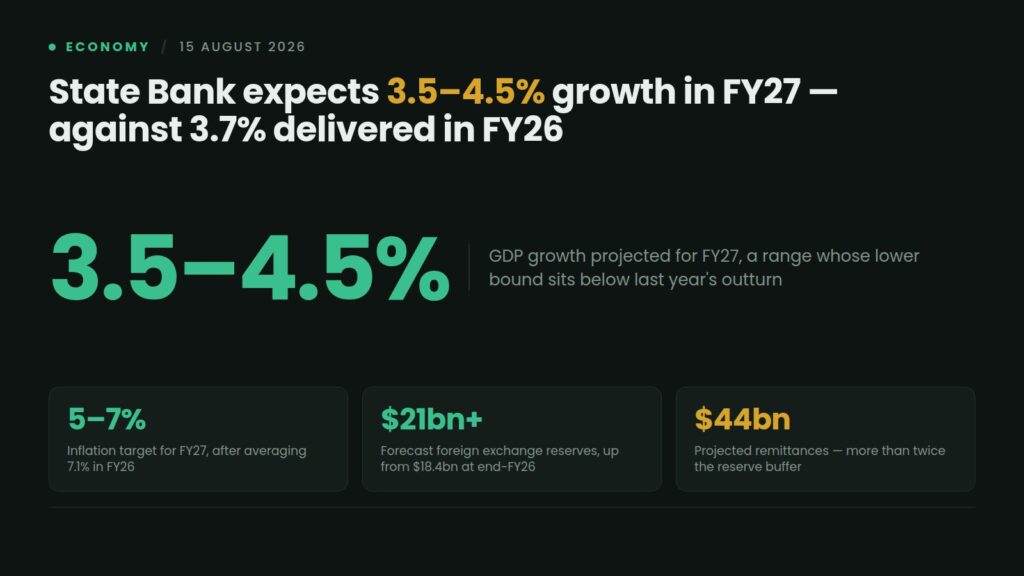
State Bank Governor Jameel Ahmad used his Independence Day address to put numbers on what the next financial year is supposed to look like. Pakistan’s economy grew 3.7 percent in FY26, and he expects 3.5 to 4.5 percent in FY27.
Read that range carefully. The bottom of it is below what the country just delivered.
A central bank forecasting a band that straddles the previous year’s outturn is not forecasting acceleration. It is forecasting that stabilisation holds, and hedging on whether anything more arrives.
The full set of numbers
- GDP growth — 3.7% in FY26, projected at 3.5–4.5% for FY27
- Inflation — averaged 7.1% in FY26, targeted at 5–7% for FY27
- Foreign exchange reserves — $18.4 billion at end-FY26, expected above $21 billion in FY27
- Remittances — over $41 billion in FY26, projected at $44 billion in FY27
Ahmad’s framing was that the economy is continuing to move towards sustainable growth following a period of stabilisation, and that the current monetary stance remains appropriate for holding inflation in range while supporting activity and job creation.
On the stabilisation half of that sentence, the record supports him. Reserves of $18.4 billion are a different country from the sub-$5 billion crisis of 2023. Inflation averaging 7.1 percent after a period in the high twenties is a genuine achievement. Neither of those is in dispute.
Why 4 percent is not enough
The problem with the growth number is demographic arithmetic.
Pakistan’s population is expanding at roughly 2 percent a year, and its labour force is growing faster than that as a large young cohort reaches working age. At 3.7 percent headline growth, per-capita income improves by well under 2 percent. At the bottom of the governor’s FY27 range, it barely moves at all.
Absorbing new entrants to the labour market — rather than merely maintaining existing employment — is generally reckoned to need growth in the 6 to 7 percent region in an economy with Pakistan’s demographics. The forecast is a little over half of that, at its optimistic end.
This is the trap the stabilisation programme built. Every time Pakistan has pushed growth toward 6 percent in the past two decades, imports surged, the current account blew out, reserves drained and the country went back to the IMF. Growth is now being deliberately held below the level at which that cycle triggers. The stability is real, and so is the cost.
The remittance dependency
The most striking number in the address is not the growth rate. It is $41 billion in remittances, forecast to reach $44 billion.
Set that against reserves of $18.4 billion. Overseas Pakistanis send home more than twice the country’s entire foreign exchange buffer every single year. Remittances comfortably exceed total goods exports.
The external account is stable because Pakistanis working abroad keep it stable. That is a real and reliable inflow, and it deserves more credit than it usually gets. It is also a form of income the state does not control, concentrated in Gulf labour markets whose demand for foreign workers is subject to their own policy choices and oil revenues.
An extra $3 billion of projected remittances does more for the FY27 reserve target than any plausible export gain. That is worth sitting with: the plan for a stronger external position rests mainly on migrants, not on manufacturing.
Inflation is the number most likely to slip
A target of 5 to 7 percent for FY27, against 7.1 percent actual in FY26, requires disinflation to continue from an already-lowered base.
The near-term signals do not obviously cooperate. Weekly sensitive price readings have been running above 9 percent, driven largely by fuel. Brent crude has climbed back above $88 a barrel on regional tensions. Domestic petrol and diesel prices were raised this week, and a further increase in dealer margins takes effect on 1 September.
Pakistan’s inflation is unusually sensitive to fuel, because fuel sets freight costs and freight costs set food prices across a country where almost everything moves by road. An oil shock does not stay in the transport line of the index.
What was also announced
The address covered infrastructure alongside the forecasts: the launch of PRISM+, the upgraded large-value payment system, a new InvestPak platform intended to widen public access to investment products, and continued emphasis on Islamic banking and green finance.
Digital transactions rose from 10 billion to 12 billion in FY26 — a 20 percent increase in a single year, and the most concrete evidence in the speech that something structural is changing rather than merely stabilising.
The honest reading
This is a credible forecast, which is exactly the criticism.
A range of 3.5 to 4.5 percent will probably be met. Reserves above $21 billion is achievable if remittances hold. Inflation in the 5 to 7 percent band is plausible absent an oil shock. Nothing here is fantasy, and Pakistani economic forecasting has produced enough fantasy to make that worth noting.
But a forecast that is achievable without anything changing is a description of the current trajectory, not a plan to leave it. Pakistan has stopped the bleeding. On these numbers, it has not yet started growing.
Related: Pakistan’s Fiscal Deficit Hit a 22-Year Low. Cheaper Debt Did Most of the Work.
3 Comments
[…] Related: The State Bank Expects 3.5–4.5% Growth in FY27. Pakistan Already Did 3.7%. […]
[…] Related: The State Bank Expects 3.5–4.5% Growth in FY27. Pakistan Already Did 3.7%. […]
[…] Related: The State Bank Expects 3.5–4.5% Growth in FY27. Pakistan Already Did 3.7%. […]