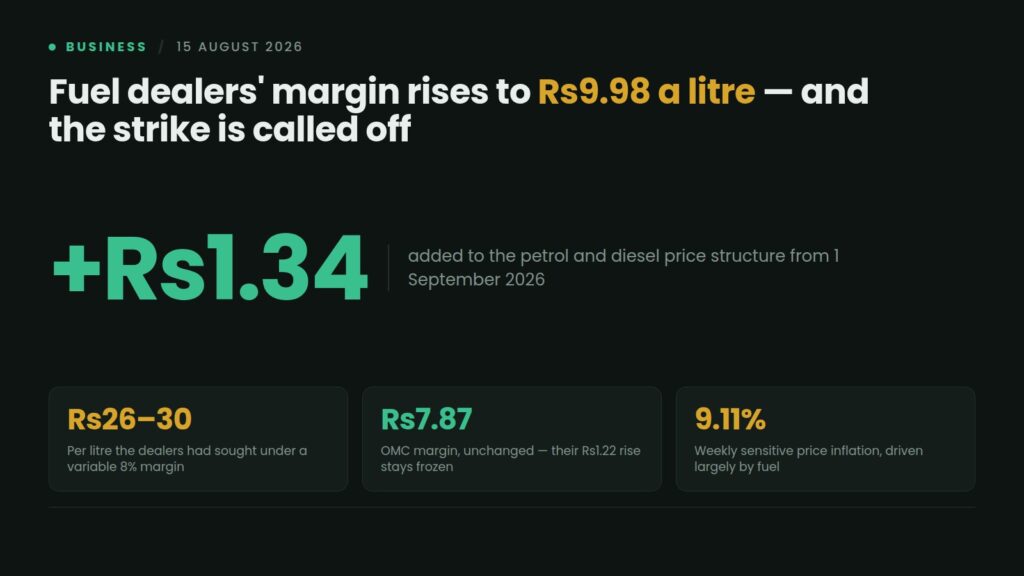
The Economic Coordination Committee has raised the petroleum dealers’ margin to Rs9.98 per litre, an increase of Rs1.34 from Rs8.64, effective 1 September 2026.
The Pakistan Petroleum Dealers Association immediately called off a nationwide strike it had scheduled to begin on 15 August. Pumps stayed open.
That is the transaction, and it is worth reading closely — because what the dealers asked for and what they received are not the same kind of thing at all.
The demand that was refused
The association was not asking for a bigger fixed margin. It was asking to change how the margin is calculated — from a fixed rupee amount per litre to a variable margin set at 8 percent of the retail price.
At current pump prices that formula would have delivered roughly Rs26 per litre on petrol and Rs30 per litre on diesel.
Against the Rs9.98 actually granted, the gap is enormous. Dealers sought something in the region of two and a half to three times what they got.
The structural change mattered more than the number. A percentage margin indexes dealer income to the retail price, which means it rises automatically whenever crude rises, the rupee weakens or the government lifts the petroleum levy. It would have converted every future fuel price increase into an automatic dealer pay rise — and passed the cost to motorists without any further decision being taken.
The government said no to the mechanism and yes to a one-off adjustment. On consumer protection grounds, that is the right call.
What it costs at the pump
Rs1.34 per litre is the direct addition to the price structure from 1 September.
For a motorcycle rider filling four litres a week, that is a little over Rs5. For a household car doing 40 litres a month, about Rs54. Individually, close to invisible.
At national scale it is not. Pakistan consumes petroleum products in the region of a billion litres a month across motor spirit and high-speed diesel. Rs1.34 on each of those litres is a transfer measured in billions of rupees a month, moving from fuel buyers to roughly 13,000 filling stations.
The timing compounds it. Petrol went up Re0.45 and high-speed diesel Rs1.16 in the fortnightly revision that took effect on 14 August. Brent has climbed back above $88 a barrel. Weekly sensitive price inflation is running above 9 percent, with fuel a principal driver. The margin increase lands on top of all of it.
The OMC increase that is still frozen
Oil marketing companies — the firms that import, store and distribute the fuel dealers sell — stay on Rs7.87 per litre. Their own approved increase of Rs1.22 remains withheld, conditional on completing digitisation measures.
This is the most interesting line in the decision, because that same conditionality was applied to dealers in December 2025 and was the source of their frustration. Margins were approved, digitisation was not completed, and the money never arrived.
The digitisation requirement exists for a good reason. Automating flow measurement at depots and pumps is how the state gets a reliable count of how much fuel actually moves — which is how it detects smuggled product entering the retail chain and adulteration at the nozzle, both long-running problems that cost the exchequer real revenue and cost motorists real value.
By granting dealers their increase while the digitisation condition still binds the OMCs, the ECC has weakened its own leverage. The message to any party subject to a conditional approval is that the condition is negotiable if the disruption threatened is large enough.
Two strikes in one month
The dealers’ threat came in the middle of a nationwide goods transporters’ stoppage that has kept large numbers of vehicles off the roads for over a week. Container operators remain divided and the wheel-jam continues; the oil tankers association dissociated itself after reaching its own agreement with regulators.
A fuel retail shutdown arriving in the same fortnight would have compounded a supply disruption the economy was already absorbing. The government had limited room to test whether the threat was real, and the dealers knew it.
That is the pattern worth watching across both disputes: sectors that can physically halt the movement of goods are extracting concessions in sequence, and each settlement establishes the terms for the next request.
Where this leaves things
Dealers have a case. Their margin is fixed in rupees while their costs — wages, electricity, rent, the working capital tied up in a tank of fuel — have inflated substantially. A margin that does not move for years is a real income cut.
The answer to that is periodic review, which is what happened. The answer is not automatic indexation, which would have removed the review entirely and handed dealers a claim on every future price rise.
The government got the structure right and paid for it in cash. Whether the OMCs now hold to the digitisation condition, or read this week as proof that conditions can be waited out, is the part that will matter in a month.
Related: 400,000 Trucks Are Parked. Pakistan’s Factories and Export Orders Are Next.
One comment
[…] Related: Fuel Dealers Wanted Rs26 a Litre. They Got Rs9.98 — and Called Off the Strike. […]
Comments are closed.