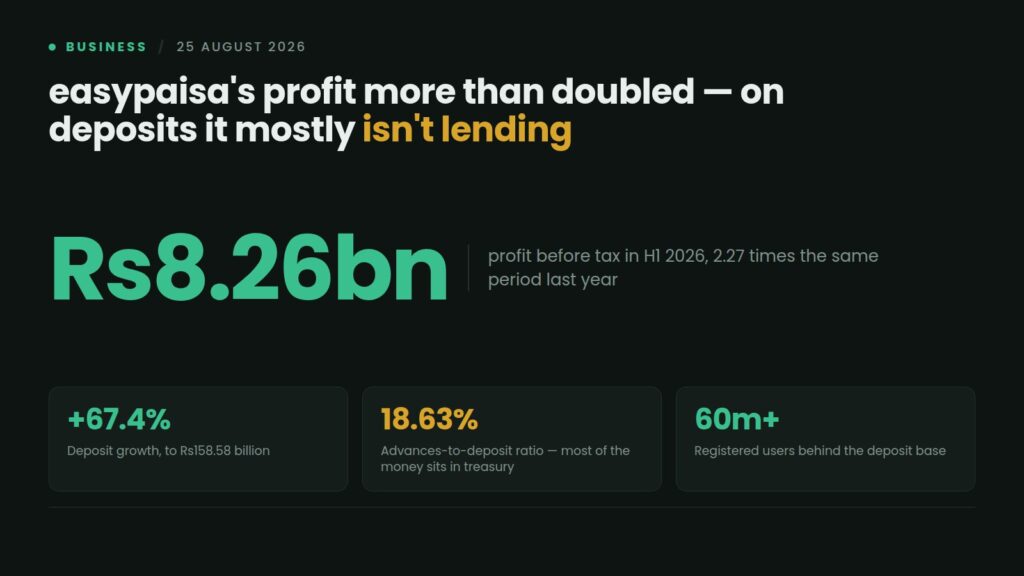
easypaisa reported profit before tax of Rs8.26 billion for the first half of 2026 — 2.27 times the same period last year. Profit after tax was Rs5.78 billion, earnings per share Rs9.61.
Revenue grew 30.5 percent. Deposits grew 67.37 percent.
Profit more than doubling on revenue growing 30 percent is the arithmetic worth pausing on, because it says something specific about how this business now works.
Operating leverage, arriving
A digital bank spends enormous sums before it earns anything. Building the app, acquiring customers, signing merchants, and meeting regulatory capital requirements are all costs incurred ahead of revenue. easypaisa’s operating expenses were still Rs21.08 billion in this half.
Those costs do not scale with usage the way a branch network does. Once the platform exists, the marginal cost of another customer transacting is close to zero. Revenue rising 30 percent against a cost base that grows far more slowly is what produces a 127 percent jump in pre-tax profit.
That is the moment every digital financial services business is built toward, and Pakistan’s consumer internet reached a comparable point this year when Daraz turned profitable at group level. Both describe the same shift: platforms built during the cheap-capital era finally covering their own costs.
The deposit number is the real achievement
Customer deposits reached Rs158.58 billion, up 67.37 percent year-on-year, against total assets of Rs232.58 billion.
Deposits are the cheapest funding a bank can have, and they are the hardest thing for a digital entrant to win. Persuading someone to move money into an app-only institution requires a level of trust that conventional banks accumulated over decades of branch presence.
Two-thirds growth in one year, on a base of more than 60 million registered users, indicates that trust threshold has been crossed for a meaningful segment. PACRA upgrading the long-term rating to AA- in July reflects the same judgement from a different direction.
What it is not doing yet
The advances-to-deposit ratio is 18.63 percent. Gross advances are Rs31.11 billion against Rs158.58 billion of deposits.
That is very low for a bank. It means roughly four-fifths of customer money is not being lent to customers — it is in treasury investments, which the results confirm as a driver of the 32.46 percent rise in net markup income.
So a substantial share of this profit comes from the same trade every Pakistani bank has been running: take deposits, buy government paper, earn the spread. It is safe, it is profitable, and it is not financial inclusion. Money gathered from 60 million users and lent back to the state does not fund a small business or a household.
The gap is also the opportunity. A bank with an 18.63 percent ADR and a young deposit base has enormous room to lend before it approaches the limits conventional banks operate at.
Watch the credit quality as it lends
Non-performing loans over 90 days sit at 3.16 percent, with coverage of 159.63 percent and a capital adequacy ratio of 23.75 percent — comfortably above requirement.
Those are sound numbers on a small book. They are not yet a test of anything.
The expansion plan — Islamic banking, foreign exchange, buy-now-pay-later and credit cards — points at unsecured consumer credit, which is where digital lenders make money and where they get hurt. System-wide credit card debt in Pakistan is already growing at 30.5 percent, and card balances are the first place household stress appears.
A 3.16 percent NPL ratio on Rs31 billion of advances tells you little about what a much larger, more consumer-weighted book does through a tightening cycle.
Where the fee income comes from
Fee-based income grew 28.34 percent, driven by payment services and insurance — and that split is worth separating.
Payments in Pakistan are becoming a poor place to earn fees. Raast moves peer-to-peer transfers free at the point of use, by design, and the State Bank’s whole direction of travel is toward cheaper digital payment rails. A business built on charging for transfers is building on a shrinking base.
Insurance is different. Distributing a policy through an app to a customer who has never held one carries a commission that does not compress the way transfer fees do, and it reaches people conventional insurers cannot economically serve. The same logic sits behind easypaisa’s move into Islamic banking and the Umrah savings products the sector has been launching.
Which of those two lines grows faster over the next four halves says more about the durability of this profit than the headline multiple does.
The competitive picture just changed
These results land in the same month Zong launched Z-Wallet with Zindigi inside the My Zong App, putting JS Bank-powered services in front of 22 million monthly active users without a separate download.
That is a direct challenge to easypaisa’s model. easypaisa’s advantage is a standalone app people have chosen to install and trust with deposits. Embedded finance attacks precisely that advantage by removing the install decision — and every operator that copies it removes it again.
easypaisa’s answer is the balance sheet: it holds a banking licence, Rs158 billion of deposits and AA- paper, none of which a wallet embedded in a telecom app has. The next two years decide whether the licence or the distribution matters more.
Related: Zong Just Put a Bank Inside Its Own App. 22 Million Users Are Already There.