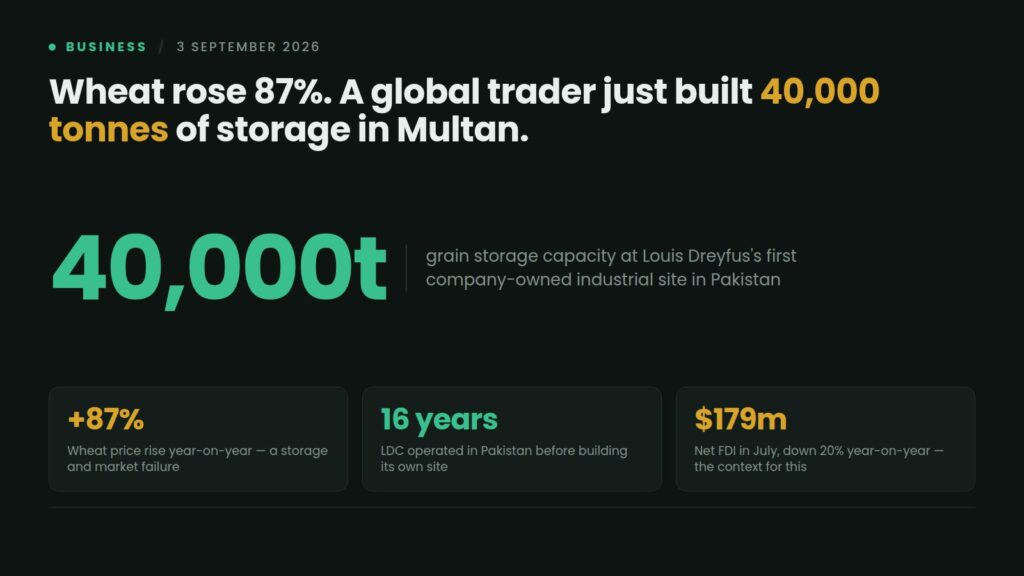
Louis Dreyfus Company — one of the handful of firms that dominate global agricultural commodity trading — has opened a 40,000-tonne grain storage facility in Multan. It is the company’s first company-owned industrial site in Pakistan, after sixteen years of operating here.
Wheat prices rose 87 percent year-on-year in August. Wheat flour rose 73 percent.
Those two facts belong in the same sentence, and the connection runs through storage.
Why storage moves prices
Grain is harvested in weeks and eaten across a year. Everything between those two facts is storage, and storage is where agricultural price stability is won or lost.
A farmer without access to storage must sell at harvest, when everyone else is selling and prices are at their lowest. A buyer with storage can hold, and sell later into a tighter market. The margin between those two positions is not created by anyone’s skill — it is created by who owns a warehouse.
Inadequate storage also means losses. Grain kept badly is lost to moisture, pests and spoilage, and every tonne lost is a tonne that has to be replaced from somewhere.
An 87 percent annual rise in the price of the national staple is not caused by a single bad harvest. It is what happens when supply, storage and market structure all fail at once.
The same lesson keeps appearing
Pakistani agriculture has produced a run of stories this month that all reduce to the same mechanism.
Tobacco growers in Khyber Pakhtunkhwa are being offered Rs350 per kilogram against an official minimum of Rs740, because the ministry that sets the rate cannot enforce it — and because a grower with a perishable crop, no warehouse and a loan against the harvest cannot wait for a better offer. Cotton arrivals sit at roughly half their 2023 level. The government exported 108,000 tonnes of sugar it had imported the year before, having bought at the top of the price cycle and sold at the bottom.
In each case the party who could store had the power. Storage is not logistics. It is bargaining position.
Who benefits from this facility
Here the honest answer is more complicated than the announcement suggests.
Louis Dreyfus is a commodity trader. Its business is buying, storing, moving and selling agricultural goods, and it profits from the spread between those transactions. LDC’s Pakistan country head says the investment will improve services for suppliers and customers and strengthen supply chains, which is true and is also how the company makes money.
Additional storage capacity in a country short of it is genuinely useful. Farmers gain a buyer with the capacity to take volume at harvest, which is better than no buyer. Losses fall.
But 40,000 tonnes owned by a global trader is 40,000 tonnes of storage power sitting on the buyer’s side of the market. It does not give the grower the ability to wait. That would require storage the farmer can access on their own account, or a cooperative structure — the model being tried with the women-led biomass cooperative supplying Pakistan’s first bio-coal plant.
What the investment signals
Set against Pakistan’s foreign investment record, this is worth marking.
Net FDI was $179 million in July, down 20 percent year-on-year. Moody’s listed minimal foreign direct investment among the structural weaknesses keeping Pakistan seven notches below investment grade. Most of what does arrive goes to power projects under guaranteed-return tariffs or into existing financial institutions — not into building things.
A trading house committing to its first owned industrial site after sixteen years of operating through others is a different category. Companies do not build fixed assets in markets they expect to leave, and LDC’s regional head calling Pakistan an important grain market and a key South Asian destination is a commercial judgement rather than a diplomatic one.
No investment figure, employment number or completion timeline has been published, which limits how much weight the announcement can carry.
Why Multan
The location is not incidental. Multan sits in southern Punjab, in the middle of the country’s main wheat and cotton belt, on the road and rail corridor running from the agricultural districts down toward Karachi.
Storage built close to production is worth more than storage built near a port, because grain is bulky and low value per tonne — the cost of moving it is a large share of what it is worth. Taking it off the field into local storage removes the pressure to sell immediately and removes a leg of trucking.
That matters in a country where road freight has proved fragile. A goods transport strike last month idled thousands of vehicles and backed containers up at Karachi’s ports within a week. Anything that reduces the number of times a tonne of grain has to move is worth having.
The larger gap
Pakistan is among the world’s largest wheat producers and has just recorded an 87 percent increase in the price of wheat. That combination is a storage and market-structure failure, not a production one.
One 40,000-tonne facility does not close it. What it does is demonstrate that the gap is commercially attractive enough for one of the world’s largest traders to put its own capital into.
Related: Inflation Is Back in Double Digits. Wheat Is Up 87% and Petrol Carries Rs116 in Tax.