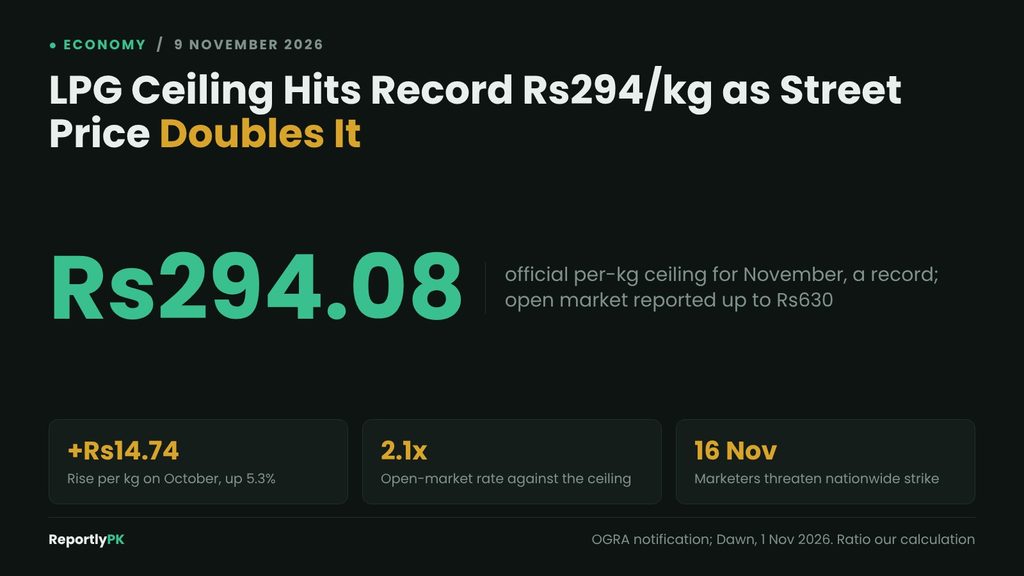
The official LPG price in Pakistan has climbed to its highest level on record, but the notified figure is rapidly becoming the least useful number in the market. The Oil and Gas Regulatory Authority (OGRA) set the consumer ceiling at Rs294.08 per kilogramme for November, yet households in several cities are reportedly paying up to Rs630 a kilogramme, more than twice the rate the regulator published. A supply squeeze blamed on the closure of the Iran border has opened a gap between the notified price and the street price that is now wider than the price itself.
What OGRA Actually Notified
The November notification lifted the consumer ceiling from Rs279.34 to Rs294.08 per kilogramme, an increase of Rs14.74 or 5.28 per cent. For the standard 11.8 kilogramme domestic cylinder, that takes the official price from Rs3,296.23 to Rs3,470.09, a rise of Rs173.86. The arithmetic ties out cleanly: Rs294.08 multiplied by 11.8 gives Rs3,470.14, within rounding of the notified cylinder rate.
OGRA attributed the revision to two inputs. The Saudi Aramco contract price, the international benchmark that sets the cost of the product itself, rose 6.47 per cent. The average rupee-dollar rate moved 0.12 per cent in the consumer’s favour. Together those two movements account for the Rs14.74 increase. Distributor and marketing margins and the petroleum levy were left unchanged.
A Labelling Slip Worth Noting
Several reports have described Rs294,075 per tonne as the new producer price, up from Rs279,341. Those figures are the consumer ceiling expressed per tonne rather than per kilogramme, because Rs294,075 per tonne is Rs294.08 per kilogramme, exactly the retail number. The actual ex-producer price is materially lower, with margins, the petroleum levy and sales tax stacked on top of it to reach the consumer rate.
The distinction is not pedantic. It explains why the consumer price rose 5.28 per cent while the underlying product cost rose 6.47 per cent. Because the margins and the levy are fixed in rupees per tonne rather than set as percentages, they dilute any move in the international benchmark by the time it reaches the cylinder. A reader who assumes the producer price and the retail ceiling are the same number will draw the wrong conclusion about who captured the increase.
The Ceiling Is Not the Street Price
OGRA sets a maximum, not a market price, and in a shortage the maximum stops binding. Open-market rates of up to Rs630 a kilogramme are about 2.14 times the official ceiling. Company-operated franchises are reported at up to Rs400 a kilogramme, roughly 1.36 times the notified rate. Applied to an 11.8 kilogramme cylinder, Rs630 a kilogramme works out at about Rs7,434 against the official Rs3,470, a gap of close to Rs3,964 per refill. That cylinder conversion is our own calculation from the reported per-kilogramme rate rather than a published figure.
LPG matters disproportionately to households beyond the piped gas network, which means the burden of the premium lands on exactly the consumers least able to absorb it, in areas where there is no alternative cooking fuel.
Related: Pakistan Inflation Climbs to 9.6 Percent in October 2026
A Supply Claim That Does Not Add Up
Industry bodies blame the shortage on the closure of the Iran border amid the wider regional conflict. Irfan Khokhar, chairman of the LPG Distributors Association of Pakistan, says at least 70 per cent of supply is imported from Iran and only 30 per cent produced locally, and has called for action against market manipulation.
That split does not reconcile with figures given by the other association. Ali Haider, chairman of the Pakistan LPG Marketers Association, puts total volume at around 1.3 million tonnes, of which about 225,000 tonnes comes from the Gulf, or roughly 17 per cent. If Iranian supply were 70 per cent of the total, that would be about 910,000 tonnes, leaving some 165,000 tonnes, or under 13 per cent, for domestic production. Khokhar’s own 30 per cent local share cannot hold alongside it, and the Gulf imports have nowhere to fit at all. Both men lead interested parties in a pricing dispute with the government, and neither set of numbers should be taken as settled without an official supply breakdown.
A Strike Threat for 16 November
Marketing companies have threatened to suspend operations nationwide from 16 November if the government proceeds with a new LPG policy they say sidelines the private sector. The associations want deregulation maintained, and say a draft went to the prime minister without consulting private-sector stakeholders. They have written to Petroleum Minister Ali Pervaiz Malik objecting to the process.
Their substantive complaint reaches back to the 2016 policy, which imposed a levy of Rs4,669 per tonne on locally produced LPG to fund emergency imports by state entities. The marketers allege those entities failed to import adequately despite the sums collected, and point to the state-run ProGas terminal at Port Qasim as having last imported months ago. That allegation, if documented, would matter more than the current price notification.
Why Petrol Fell While LPG Hit a Record
The divergence confuses consumers reasonably enough. Petrol prices fell sharply in the same period while LPG set a record. The two fuels are priced off different benchmarks, with petrol tracking refined product quotations and LPG following the Saudi Aramco contract price, and they are supplied through entirely separate logistics. A border closure that strangles LPG trucking has no effect on seaborne petrol cargoes. Falling pump prices therefore say nothing about the cost of a cylinder, and the record ceiling is the smaller problem: the enforcement gap between Rs294 and Rs630 is where the real cost is sitting.