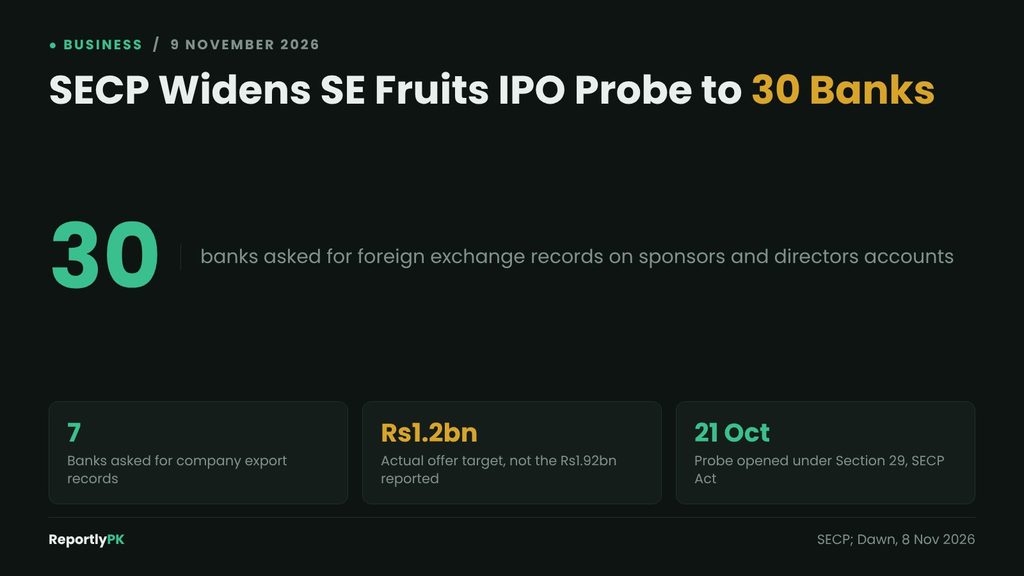
The SE Fruits IPO probe has moved decisively beyond the offer document and into the banking system. The Securities and Exchange Commission of Pakistan (SECP) has sought export records from seven banks and has asked a further thirty for details of foreign remittances, export proceeds and other foreign exchange transactions credited to accounts held by the company’s sponsors and directors. The regulator is no longer testing what SE Fruits and Vegetable Limited said about itself. It is testing whether the money moved.
What the SECP Has Asked For
The two requests are different in kind, which is why reports citing seven banks and reports citing thirty are both accurate. The seven-bank request targets the company’s export records, the documentary trail behind the revenue the prospectus presented to investors. The thirty-bank request reaches wider and deeper, covering inward remittances and foreign currency flows into the personal accounts of sponsors and directors rather than the corporate accounts.
Some banks have already responded and those replies are under examination. The combination of requests suggests the regulator is reconciling claimed export earnings against what the banking channel actually recorded, and separately checking whether funds attributed to the business passed through individuals connected to it.
The Legal Basis and the Timeline
The investigation was opened on 21 October under Section 29 of the SECP Act, 1997, read with Section 139 of the Securities Act. Section 29 is the regulator’s general investigative power, and invoking it alongside the securities legislation gives the SECP authority to compel records from third parties such as banks, depositories and advisers rather than only from the issuer.
That matters for how seriously to read this. A regulator reviewing a prospectus asks the company questions. A regulator compelling thirty banks to produce foreign exchange records on named individuals has formed a view that the documents on file may not be sufficient.
Correcting the Rs1.92 Billion Figure
A number circulating in coverage of this story needs correcting. Several outlets have described the offering as a plan to raise Rs1.92 billion by selling 30 million shares at Rs40 each. Those figures are not compatible. Thirty million shares at Rs40 is Rs1.2 billion, not Rs1.92 billion.
The Rs1.92 billion figure is what the offer would have raised at the ceiling of its indicative price band, which works out at Rs64 a share across the same 30 million shares. The book build struck at the Rs40 floor rather than the ceiling, so the target was Rs1.2 billion. Describing Rs1.92 billion as the intended raise overstates the offering by 60 per cent and quietly erases the most informative fact about it, which is that institutional demand priced it at the bottom of the range.
The offering was subsequently halted by the SECP and then withdrawn by the company, with subscription money returned. No capital was ultimately raised from the public.
Related: SECP Orders Refunds as SE Fruits IPO Probe Opens
The Advisers Under Review
The regulator has not confined itself to the issuer. Information supplied by the joint lead managers, Topline Securities and Growth Securities, is under review. The response of the consultant, Parker Russell-A.J.S., is being examined. The auditor, Ilyas Saeed and Co., requested and was granted an extension to furnish the records sought from it.
No finding has been made against any of them, and the grant of an extension is routine. But the breadth of the request is the point. Lead managers conduct due diligence, consultants prepare the financial presentation and auditors sign the accounts. Pulling all three files at once indicates the SECP is examining whether the gatekeeping worked, not simply whether the issuer was candid.
What the CDC Has Handed Over
The Central Depository Company initially provided a list of investors. The SECP then went further and sought shareholder lists together with transfer histories for persons named in the prospectus. The CDC supplied a partial response on 2 November, which remains under review.
Transfer histories are a specific and revealing request. A list of current holders shows who owns shares now. A transfer history shows when stock moved between accounts and between whom, which is how a regulator would identify shares parked with associates, pre-offer transfers to connected parties, or any mismatch between the shareholding the prospectus described and the register behind it.
What the Probe Is Likely Testing
Read together, the requests outline a coherent line of inquiry. Export records from the company’s banks would verify whether the revenue presented to investors was real. Foreign exchange flows into sponsors’ and directors’ personal accounts would show whether earnings attributed to the business were actually received by individuals. Depository transfer histories would establish who really held the stock. Adviser files would show what checking was done before any of it reached the market.
None of this amounts to a conclusion, and the SECP has made no public allegation of wrongdoing. The company and its advisers are entitled to the presumption that the records will support what was filed. What can be said is that the regulator halted an offering at the subscription stage, returned investors’ money and then opened a document trail reaching into three dozen banks, a depository, two brokerages, a consultancy and an audit firm. For a market where IPOs are scarce and retail confidence is thin, the outcome of the SE Fruits case will say more about Pakistan’s listing standards than the size of the offer ever would have.