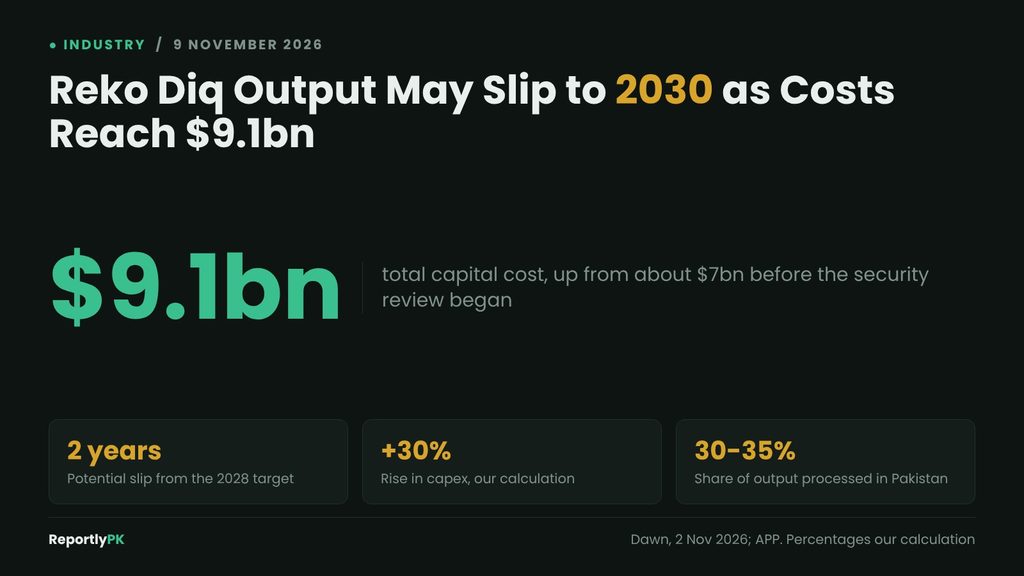
First Reko Diq production could slip from 2028 to 2030, a two-year delay that would push Pakistan’s largest single foreign investment well into the next decade before it earns a rupee. The capital bill has already climbed to roughly $9.1 billion from about $7 billion, Barrick Mining has extended a security review it began in February, and full-scale development is not expected to resume before the middle of 2027. The company has made no official announcement of a revised schedule.
A Two-Year Slip, Not Yet Officially Confirmed
The revised timeline is conditional on two things outside anyone’s control in Islamabad: improved security in Balochistan and de-escalation in the Middle East. Barrick opened a formal review of the project in February 2026 and has since extended the assessment period into early 2027. Speaking at the Mining Forum Americas, the company’s chief executive declined to give a new construction timeline, saying only that the schedule is being revisited because, in his words, the project needs “some sort of security improvement”.
It is worth being precise about the status of the 2030 date. It is not a Barrick announcement. It is what the delay implies if full-scale development resumes by mid-2027 on the construction schedule previously disclosed. Company sources have described speculation about the project’s future as baseless, and insist research, administration and community development continue normally. Barrick and senior government officials did not respond to requests for comment.
Capital Cost Has Risen Thirty Percent
Phase 1 has gone from an original $4 billion to $5.6 billion. Phase 2 is projected at $3.5 billion. That gives total capital expenditure of about $9.1 billion against an earlier figure of roughly $7 billion, an increase of some $2.1 billion or about 30 per cent on our calculation.
What the money buys has been restated too. Initial throughput is 45 million tonnes of ore a year, doubling to 90 million tonnes after Phase 2. Mine life has been trimmed from 40 years to 37, although exploration could extend it to as much as 80. Projected free cash flow across the 37-year life is put at $74 billion, which averages about $2 billion a year. Nearly $1 billion has already been spent on the ground.
How Far Could a Delay Push Costs?
Here the estimates diverge wildly, and the gap is instructive. A private-sector source has warned that costs could rise by a further $8 billion to $10 billion. An insider connected to the Reko Diq Mining Company dismissed that as bordering on absurdity, putting the delay-related increase at up to 10 per cent, or roughly $450 million to $900 million.
The arithmetic favours scepticism about the larger number. An $8 billion to $10 billion increase would take total capex to $17 billion or $19 billion, meaning the delay alone would cost more than the entire original project. The insider’s range, by contrast, is about 5 to 10 per cent of the current $9.1 billion estimate, which is the order of magnitude a two-year standstill on a project of this type would normally imply. Both sources are interested parties, and neither figure is an audited company estimate.
One point gets lost in the cost argument. A delay defers cash flow rather than destroying it. At an average $2 billion a year, two years of slippage postpones roughly $4 billion of gross cash generation, but the ore does not go anywhere. The real economic loss is the time value of that money and the holding cost of a workforce and site kept idle.
Related: Barrick Slows Reko Diq Construction Over Security Concerns
Who Owns What, and Who Is Still Employed
Barrick holds 50 per cent of the project. The other half sits with the Balochistan government and three state-owned entities: Pakistan Petroleum, the Oil and Gas Development Company and Government Holdings (Private) Limited. That structure means the delay is not only a foreign investor’s problem. Half the exposure is Pakistani, and a quarter of it is the provincial government’s.
The project has retained 700 permanent staff and about 2,000 contract workers, while allowing some third-party service contracts to lapse. At peak construction it is expected to employ up to 7,500 people, settling at around 4,000 permanent jobs once operational. Those are the numbers a two-year delay postpones, in a province where the employment case has carried much of the political weight behind the project.
The Processing Question Pakistan Should Be Asking
Buried beneath the timeline story is a more consequential disclosure. The operator reportedly plans to process only 30 to 35 per cent of the copper and gold output inside Pakistan, with the remainder potentially routed to its Australian facility. An insider expressed regret about the arrangement.
If that holds, between 65 and 70 per cent of the smelting and refining value-add on Pakistan’s largest mineral deposit happens offshore. Concentrate exports earn a fraction of what refined metal earns, and they create far fewer downstream industrial jobs. A delay to 2030 is recoverable. A processing split locked in at the design stage is much harder to revisit later.
Thornton Comes to Islamabad This Week
Barrick chairman John L. Thornton is expected in Islamabad on 12 and 13 November for the Pakistan Minerals Investment Forum 2026, alongside Ivanhoe Mines founder Robert Friedland and representatives of the Asian Development Bank and Wood Mackenzie. The forum is endorsed by the Special Investment Facilitation Council, with OGDC as founding partner and its managing director Ahmed Hayat Lak serving as PMIF president. Reko Diq Mining Company is among the listed participants.
The timing is awkward and useful in equal measure. Pakistan is marketing its mineral potential to global investors in the same week its flagship mine is reported to be slipping two years. If a revised Reko Diq schedule is going to be confirmed anywhere, Islamabad this week is the likeliest venue.