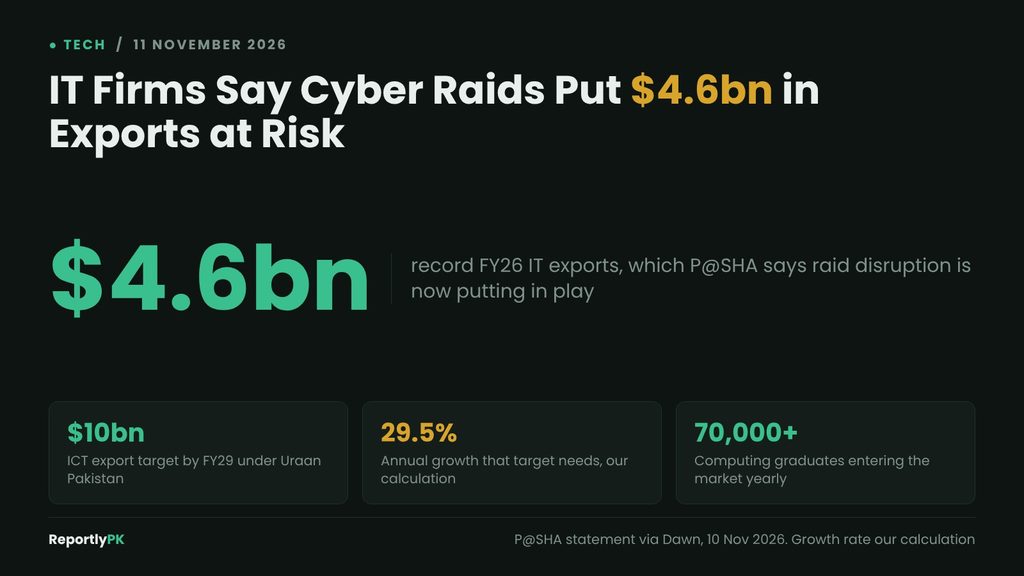
Pakistan’s software industry has gone public with a complaint about law enforcement. The Pakistan Software Houses Association, better known as P@SHA, says NCCIA raids on legitimate IT and IT-enabled services firms are increasing, and that the way they are being conducted is putting client contracts and the country’s record $4.6 billion in technology exports at risk. The association is not asking the National Cyber Crime Investigation Agency to stop pursuing fraud. It is asking the agency to stop treating software houses and scam centres as the same thing.
What P@SHA Says Is Happening
According to the association’s statement, member companies have reported teams entering offices without producing a warrant, detaining and questioning staff for hours, and seizing laptops, servers and phones. In some cases this reportedly happened even where nothing unlawful was found. P@SHA has not published a count of the companies affected, and the complaints are attributed to unnamed members rather than documented case by case.
That caveat matters, and it cuts both ways. P@SHA is an industry body whose job is to defend its members, so its account is an interested one. But the specific allegation, that equipment holding client data was removed from premises without a warrant on display, is the kind of claim that is straightforward for the agency to rebut with paperwork if it is wrong. No NCCIA response had been reported at the time of writing.
The Export Number That Makes This Urgent
Pakistan’s IT exports reached a record $4.6 billion in FY26, up from $3.8 billion in FY25. That is growth of about 21 per cent on our calculation, in a year when most of the country’s other export categories moved by low single digits. Technology is currently the fastest-growing thing Pakistan sells abroad, and it sells it without ports, containers or a trade route that can be closed.
The association also points to more than 70,000 computing graduates entering the market each year. The supply of people is not the constraint. What constrains the sector is whether overseas clients will place work here, and that is a question about perceived reliability rather than capability or price.
Related: Pakistan IT Exports Reach $435 Million in September
The Target Already Requires Acceleration
The government’s stated goal under Uraan Pakistan is $10 billion in ICT exports by FY29. Getting from $4.6 billion to $10 billion in three years implies compound annual growth of roughly 29.5 per cent, by our calculation. The sector managed about 21 per cent last year.
In other words the target was already demanding a step up in pace before any of this. A policy objective that requires the industry to grow half again as fast as it currently does has very little tolerance for friction, and none at all for the kind of friction that shows up in a client’s inbox as a news story. The arithmetic is what turns a procedural grievance into an economic one.
Why Trust Is the Product
P@SHA chairman Dr Shoaib Ahmed Khan put the industry’s case in six words: “Every single dollar is earned on trust.” It is a fair description of how outsourced software work is actually bought. A foreign client hands over source code, customer records and production systems to a vendor in another jurisdiction, usually under contractual commitments about data custody and business continuity.
Seized servers break both of those commitments at once. The client’s data has left the vendor’s control, and the service has stopped. For a firm serving regulated customers in finance or healthcare, that is not an inconvenience to be explained later. It is frequently a contractual breach that must be disclosed immediately, and disclosure is what moves the next contract to a competitor in another country.
The Problem NCCIA Is Actually Chasing
None of this means the crackdown is baseless. Organised fraud operations, often running investment, romance or fake-support schemes aimed at victims overseas, do set up inside Pakistan and do present themselves as call centres or software houses. P@SHA itself acknowledges that NCCIA has identified fraud operators registering as IT companies. The agency is chasing something real, and a scam centre is designed from the outset to look exactly like the legitimate business next door.
That is precisely why the distinction has to be made before the door opens rather than after the servers are in a van. Pakistan has a reputational interest in visibly shutting down fraud operations, because a country known as a base for them will lose legitimate work too. The industry and the agency want the same outcome. The dispute is about method.
What P@SHA Is Asking For
The association has made four requests. It wants NCCIA to distinguish registered IT firms and legitimate call centres from scam operators. It wants verification of a company’s status with the Pakistan Software Export Board and P@SHA through a designated focal person before any raid. It wants an end to media trials of IT companies. And it has restated its support for lawful, evidence-based enforcement.
The focal-point proposal is the operative one, and it is modest. A pre-raid check against the PSEB register is a phone call, not a procedural obstacle, and it would not shield a company that is actually running a fraud. What it would do is give an investigating officer a documented basis for distinguishing a registered exporter with named foreign clients from an unregistered operation with none. Whether NCCIA accepts that, and whether the warrant complaints are substantiated, is now the question. Both sides have an interest in the answer being on the record rather than in the trade press.