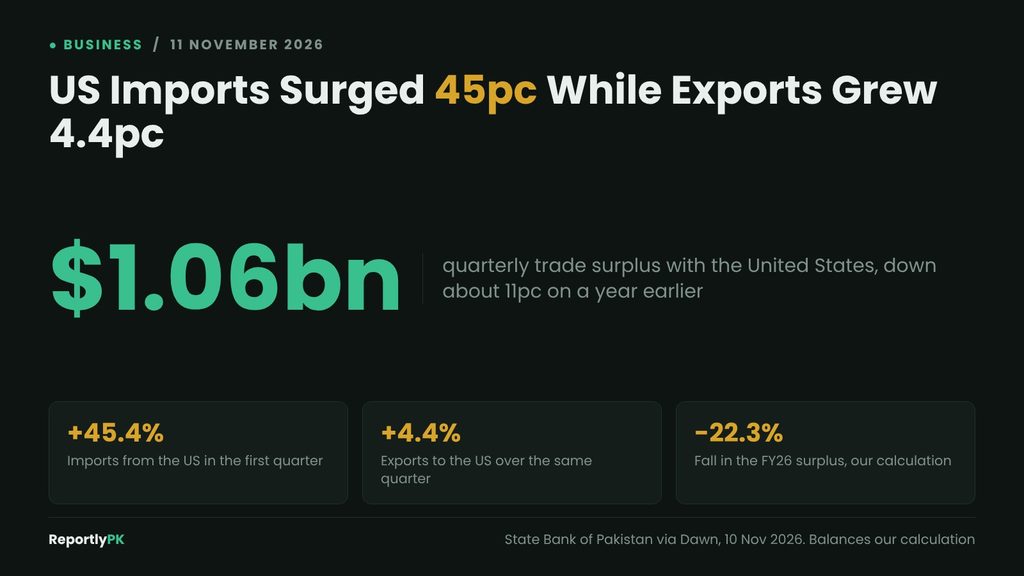
Pakistan US trade is one of the few bilateral relationships in which Pakistan sells more than it buys, and the latest State Bank figures show that surplus shrinking fast. Exports to the United States rose 4.44 per cent to $1.716 billion in the first quarter of FY27, while imports from the United States surged 45.44 per cent to $659.23 million. Imports grew more than ten times faster than exports, and on our calculation the quarterly surplus narrowed by about 11 per cent.
The Quarterly Picture
In the July to September quarter, exports to the US reached $1.716 billion against $1.643 billion a year earlier. Imports from the US climbed to $659.23 million from $453.28 million. That leaves a surplus of about $1.06 billion, down from roughly $1.19 billion in the same quarter of FY26, a fall of around $133 million or 11.2 per cent by our arithmetic.
Taking North America as a whole, exports rose 4.65 per cent to $1.826 billion and imports 60.58 per cent to $841.31 million. Canada accounted for $109.72 million of the export total, up 7.53 per cent. The United States therefore represents about 94 per cent of what Pakistan sells into the region, which makes the bilateral relationship effectively the regional one.
The Full-Year Trend Is Steeper
The quarterly erosion follows a sharper annual one. In FY26, exports to the US rose just 1.55 per cent to $6.125 billion while imports from the US jumped 38.93 per cent to $3.265 billion. That cut the annual surplus from about $3.68 billion to roughly $2.86 billion, a decline of some $821 million or 22.3 per cent on our calculation. Exports to Canada fell 2.3 per cent to $377.46 million over the same year.
Two consecutive periods of double-digit surplus erosion, driven almost entirely by the import side, is a trend rather than a fluctuation.
A Warning About Annualising the Quarter
It is tempting to multiply the first quarter by four and project the year, and in this case that would be badly wrong. First-quarter imports from the US in FY26 were $453.28 million against a full-year total of $3.265 billion. The quarter therefore accounted for only about 14 per cent of the year, not the 25 per cent an even spread would imply.
Imports from the United States are heavily back-loaded within the fiscal year, which is consistent with large lumpy purchases such as aircraft, machinery and agricultural commodities landing in later quarters. Anyone annualising the 1QFY27 import figure of $659 million would forecast around $2.6 billion and understate the likely outturn substantially. We have flagged this rather than published a projection, because the seasonal pattern makes any straight-line estimate unreliable.
Related: Pakistan GSP Plus Status Faces EU Review
The Narrowing Is Partly by Design
This is the part that distinguishes the US relationship from Pakistan’s other trade imbalances. The import surge is not simply demand running ahead of policy. Washington has imposed additional tariffs on a range of partners while extending limited relief to Pakistan under a reciprocal arrangement, and under the resulting agreement Pakistan has undertaken to buy more American goods specifically to narrow the bilateral gap.
So a shrinking surplus is, in part, the arrangement working as intended from the American side. That reframes how the numbers should be read. A 45 per cent rise in imports from a single partner would normally look like a loss of control over the import bill. Here it is at least partly the price of preserving access for $6 billion of annual exports, which is a trade worth making if the access holds.
The Asymmetry That Should Worry Exporters
The weak point is the export line. Growth of 1.55 per cent in FY26 and 4.44 per cent in the first quarter of FY27 is barely ahead of inflation in the destination market, which means Pakistan is not gaining share in the United States, it is roughly holding it. Meanwhile the concessions being given in exchange are measured in tens of percentage points of import growth.
The US is Pakistan’s single largest export destination and the composition is narrow, weighted heavily towards textiles and apparel. A relationship in which the import commitments scale quickly and the export response does not is one where the balance keeps moving in one direction regardless of intent.
There is also a currency dimension the headline percentages obscure. Both series are reported in dollars, so with the rupee broadly stable against the dollar these are close to real volume movements rather than valuation effects. That makes the 4.44 per cent export figure harder to explain away as a pricing artefact, and it makes the 45.44 per cent import jump a genuine increase in goods arriving rather than the same goods costing more.
The composition of that import surge is the detail worth pursuing when fuller data is published. If the additional purchases are capital goods, machinery and technology that lift productive capacity, a narrowing surplus is the price of investment and defensible on those terms. If they are agricultural commodities and consumer goods, Pakistan is buying market access with consumption. The State Bank aggregates released so far do not separate the two, and that distinction decides whether the arrangement is worth what it costs.
What to Watch Next
Three things will determine whether this matters. The first is whether the tariff relief Pakistan has been granted holds, since the entire calculation depends on continued preferential access. The second is the back-loaded import pattern described above, which means the FY27 picture will not be clear until the third and fourth quarters are in. The third is whether export growth to the US can move above the low single digits, which on current composition means textiles finding higher-value product lines rather than shipping more of the same.
Pakistan still runs a surplus with the United States, and in a year when the overall goods trade deficit widened 16 per cent that is worth something. But a surplus falling 22 per cent in one year and 11 per cent in the next quarter is on a trajectory, and trajectories do not stop at zero on their own.