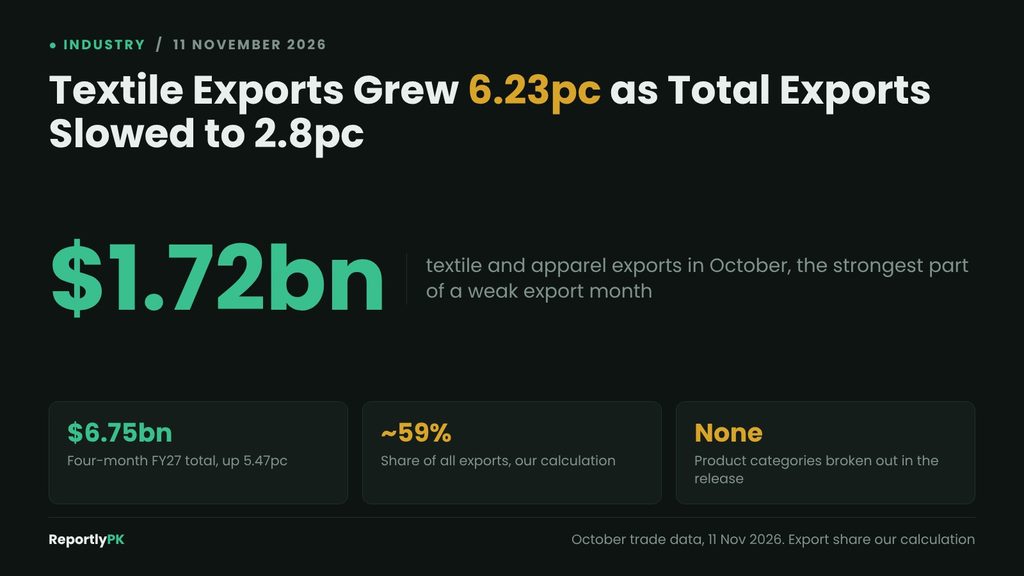
Pakistan’s textile exports rose 6.23 per cent year on year in October to $1.721 billion, outpacing the country’s overall export performance in a month when total shipments slowed sharply. Cumulative textile and apparel exports for the first four months of FY27 reached $6.75 billion, up 5.47 per cent from $6.40 billion in the same period last year. In a quarter where the headline trade numbers have been uncomfortable, the sector that carries most of Pakistan’s export weight held its ground.
The October Figures
October shipments of $1.721 billion compare with $1.620 billion in October 2025, giving the 6.23 per cent annual increase. Month on month the reported rise is 0.70 per cent, essentially flat against September.
Some coverage has presented that monthly figure as inconsistent, because $1.721 billion against a September figure quoted as $1.70 billion works out closer to 1.2 per cent. The discrepancy resolves on inspection: a 0.70 per cent rise to $1.721 billion implies a September base of about $1.709 billion, which rounds to $1.70 billion. The percentage is calculated from the unrounded figure and the two are consistent. It is a rounding artefact rather than a data problem, and worth saying so plainly because the same apparent error will appear in several places.
Textiles Outperformed the Overall Export Line
The comparison that gives these numbers their significance is with total exports. Overall export growth slowed to about 2.8 per cent in October alone, down from 10.8 per cent across the first quarter. Textiles grew 6.23 per cent in the same month, more than double the national rate.
That inverts the usual complaint about the sector. Textiles are normally described as the drag on Pakistan’s export diversification, the low-value base the country cannot grow beyond. In October they were the part holding up, and whatever caused the broader slowdown was happening outside textiles rather than within them.
How Much of the Export Base This Is
Pakistan’s four-month FY27 imports came in at about $26 billion against a trade deficit of $14.6 billion, which puts total exports in the region of $11.4 billion. Textile and apparel exports of $6.75 billion therefore represent roughly 59 per cent of everything Pakistan sold abroad in those four months, on our calculation from the published trade aggregates.
That concentration is the structural fact underneath every textile data release. When close to three-fifths of export earnings come from one sector, the sector’s monthly performance is not an industry story. It determines whether the external account works. It also means a shock specific to textiles, whether in cotton supply, energy pricing or buyer-country tariffs, transmits almost directly to the current account.
Related: Pakistani Factories Look to Egypt for US Market Access
What the Aggregate Does Not Show
The published October release gives only the combined textile and apparel total. There is no breakdown for knitwear, bedwear, readymade garments, cotton yarn, cloth or towels, which is where the question that actually matters sits.
Growth concentrated in knitwear and readymade garments means Pakistan is selling finished product with manufacturing margin attached. Growth concentrated in cotton yarn and grey cloth means the country is shipping intermediate goods for someone else to finish, earning a fraction of the value and creating fewer jobs per dollar. A 6.23 per cent headline is compatible with either. Until the category split is published, the number tells you volume moved but not whether the mix improved.
The Industry Case, and Who Is Making It
The All Pakistan Textile Mills Association has argued that the sector could add around $3 billion to exports this year given the right conditions, by which it principally means energy pricing and liquidity. APTMA is the mills’ representative body and that figure is an advocacy number produced in the course of asking for policy support, so it should be read as the sector’s best case rather than a forecast.
The underlying argument is not unreasonable. On a base of roughly $20 billion in annual textile exports, $3 billion is about 15 per cent growth, several times the current 5.47 per cent run rate. What the association is describing is the gap between what installed capacity could produce and what it currently does, and that gap is genuine. Whether it closes on energy pricing alone is a different claim and a weaker one.
Energy pricing sits at the centre of the sector’s cost argument and it is not a trivial one. Spinning and weaving are electricity-intensive, and Pakistani mills compete directly with producers in Bangladesh, Vietnam and India whose power costs are lower. Where the argument weakens is in treating tariffs as the only binding constraint. Cotton quality, lead times, compliance certification and buyer confidence in delivery dates all shape order books, and none of them is fixed by a cheaper unit of electricity.
The October figure also lands in a month when regional supply chains were disrupted by border closures and conflict in the wider neighbourhood. Holding 6.23 per cent growth through that is a better result than the number alone suggests, although it may equally reflect orders placed months earlier working their way through the system rather than fresh demand arriving now.
What Would Make This a Turnaround
Four months of 5.47 per cent growth is a solid result, not a transformation. It keeps textile exports moving upward at roughly the rate of global apparel trade, which means Pakistan is participating in the market rather than taking share from it.
Three things would change that reading. Published category data showing finished goods growing faster than yarn and cloth would indicate the mix is improving. Sustained monthly growth above the high single digits would indicate share gains rather than market drift. And evidence that new capacity is being installed rather than existing capacity being better utilised would indicate the sector believes the demand is durable. October gave a decent number. It did not yet give any of those three.